Overview: Capacity Development planning process for health programmes
Whether in its role as an implementing partner managing large-scale HIV, TB, and malaria programmes funded by the Global Fund or as a technical assistance partner for health systems strengthening interventions, UNDP prioritizes the capacity development of national entities and systems for health. Leveraging its global experience, UNDP has established a systematic approach to capacity development based on a model of end-to-end support tailored to the country context and needs of partners. Its framework for capacity development starts with a participatory multi-stakeholder process to scope the priorities and conduct a comprehensive capacity assessment that informs the development of capacity development plan.
UNDP then works closely with national stakeholders, making tools and guidance available, to support the implementation and monitoring and evaluation of the capacity development plan.
Purpose
Capacity development interventions should be based on a comprehensive understanding of how a system is currently working, what areas need support and how to prioritize investments according to the cross-cutting building blocks for resilient health systems. These could include developing and implementing health information systems, training staff in analysing data, developing policies and procedures for strong financial management, and improving the supply and distribution of key health products.
A valuable mechanism for applying a holistic and systematic approach to strengthen systems for health and the capacity of key stakeholders is the establishment of a nationally owned capacity development plan. In the context of its support to health programmes funded by the Global Fund to Fight AIDS, Tuberculosis and Malaria (The Global Fund) and the emphasis on enabling transition of grants to national entities when circumstances permit, UNDP works closely with governments and/or civil society organizations to develop costed capacity development and transition plans. These plans help partners to prioritize, implement and monitor capacity development investments and can serve as a tool to advocate for additional resources in key areas.
Whether in its role as an implementing partner managing large-scale HIV, tuberculosis and malaria programmes funded by the Global Fund to Fight AIDS, Tuberculosis and Malaria (The Global Fund) or as a technical assistance partner for strengthening systems for health, UNDP prioritizes the capacity development of national entities and systems for health. Leveraging its global experience, UNDP has established a systematic approach to capacity development based on a model of end-to-end support tailored to the country context and the needs of partners. Its framework for capacity development starts with a participatory multi-stakeholder process to establish priorities and conduct a comprehensive capacity assessment that informs the development of the capacity development plan. UNDP then works closely with national stakeholders, making tools and guidance available, to support the implementation and monitoring and evaluation of the capacity development plan.
This section offers tools and guidance for each stage of the capacity development process, whether in the context of overall health systems strengthening, civil society groups or specific programme areas. While developed through UNDP’s experiences of facilitating capacity development primarily in its role as interim Principal Recipient (PR) of programmes funded by the Global Fund, the process and tools can be adapted for different programme or policy objectives.
Success factors
From working with multiple countries carrying out capacity development processes, UNDP has identified common factors that are key to successful capacity development. These include:
national support and ownership of the capacity development plan
an objective assessment process to reach a common understanding of needs and recommendations.
adapting the capacity development approach to the specific context and circumstances of the country and organizations involved.
clarity of responsibilities, including who is responsible for implementing and evaluating the capacity development plan.
planning and budgeting for capacity development: capacity development plans and budgets, which should be developed done as part of the initial programme development to support the implementation of health programmes.
integration of capacity development plans with existing national plans and strategies, rather than seeing them as separate programmes.
involving donors and stakeholders at the planning stage, to ensure coordination of various capacity development initiatives and cost sharing.
resource mobilization, including a clear plan of all resources required in terms of both money and technical support
regularly reviewing and updating of the capacity development plan to monitor progress and make necessary changes.
ongoing and transparent communications and collaboration with all country stakeholders regarding the plan and its progress.
Nationally owned, multi-donor capacity development planning in Chad
UNDP supports capacity development planning in Chad to build resilient and sustainable system for health and transition the management of Global Fund grants to national entities. Historically, different partners working on HIV, tuberculosis, and malaria led to separate capacity development efforts. Since 2021, the MoHP and UNDP have been co-Principal Recipients of the Global Fund malaria grant. Under this model, the partners are allocated responsibilities based on their strengths, while PMU capacity is further strengthened. The aim is to fully transition the Principal Recipient role in the future.
With UNDP support, Chad’s Ministry of Health and Prevention (MoHP) created a Programme Management Unit (PMU) to coordinate capacity development and development assistance efforts nationally. Drawing on technical assistance from partners, UNDP contributed resources to develop, implement and monitor a comprehensive multi-donor capacity building plan, which promotes shared responsibility and accountability for outcomes. UNDP helped convene United Nations agencies, bilateral and multilateral partners and international non-governmental organizations to harmonize activities and investments.
Coordinating partners enabled the Government of Chad to finance three health system components: a health information system, procurement and supply management and human resources. Chad’s health information system, the Technical Assistance System (DAT), has been spearheaded by Expertise France. The DAT supports the autonomous daily management of external grant activities and capacity development plan implementation through an Expertise Channel (technical), Projects Channel (financing catalytic initiatives) and Accelerator Channel (innovating in the fight against pandemics).
Under procurement and supply management, Against Malaria Foundation has partnered with UNDP to purchase 6.8 million long-lasting insecticide treated bed nets (LLINs) in 2023. The bed nets were delivered across seven provinces with the highest malaria burden in Chad. As a funding partner, the Global Fund funded all other costs besides the LLINs, such as transport and distribution. The Global Fund and the national government also raised funds to cover other provinces, ten and two provinces, respectively, to cover 19 provinces and 18.9 million people with 11.6 million LLINs in total.
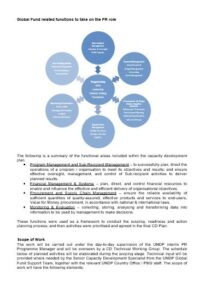
Human resource support included UNDP coaching four national counterparts, French technical assistance funding for four international experts within the PMU and a progressive transfer of responsibilities for grant management. In 2018, the PMU became Sub-recipient of the Global Fund malaria grant, for which UNDP has been interim Principal Recipient since 2008. In January 2019, the MoHP became Principal Recipient of the Global Fund’s HIV, tuberculosis and health system strengthening grant, with technical assistance from the French 5% Initiative.
Scoping and design of the Capacity Development planning process
Purpose
Successful and sustainable capacity development can only occur when there is commitment from individuals who invest in the process from the design stage onwards. Engaging stakeholders to build consensus from the time of designing the capacity development process is vital to ensure that all country partners are kept informed, consulted and engaged as necessary. Each organization will have a different role and view of the capacity development effort. UNDP works with organizations to bring country stakeholders together, along with tools to outline the scope and process for the capacity development.
Define scope and design the capacity development approach
Just as programmes should be designed with the aim of achieving national goals and objectives to ensure a coordinated approach and the best use of all available funds, capacity development processes should seek to ensure alignment with national health strategies and disease-specific strategic plans.
UNDP’s approach
UNDP is able to bring together a wide variety of groups working in the health sector, from civil society organizations to government and donor groups. UNDP facilitates workshops and consultation meetings for groups to engage in country dialogue to ensure the views of all country stakeholders, from direct implementers to policymakers, are reflected. UNDP develops tools to suit the needs of all groups and provides examples of successful capacity development activities in different countries. The scoping and design stage entails a joint process to:
Analyse stakeholders: identify all stakeholders and their perspectives, levels of involvement, preferred methods of communication, and readiness for capacity development. In particular, attention should be given to key affected populations (KAPs) and how they can engage with the process.
Review institutional arrangements: clarify the institutional structure and arrangements for implementing health programmes, with lines of accountability, oversight roles and staff roles and responsibilities.
Define the capacity development team and roles: identify organizations and individuals to oversee, manage and support the capacity assessment and planning process and, if possible at this stage, also the implementation. This is particularly important if more than one
Plan and manage communications: ensure appropriate communications with the identified stakeholders, including through scheduling and conducting launches, meetings, workshops, newsletters, surveys, and electronic communications (websites, knowledge sharing systems, emails).
Guidance
The following points should be considered when scoping and designing the process.
methods should be appropriate for the context. The most appropriate communications methods are dependent on the country, culture, organization(s), context and situation. For example, in some scenarios, a workshop may be more appropriate than a questionnaire given to individuals. Other alternatives include one-on-one discussions or small focus groups.
there is a need for ongoing communications and engagement. Stakeholder engagement and consensus building should be conducted throughout the capacity assessment, planning, and implementation cycle, helping to ensure sustainable and coordinated capacity development.
country ownership and partnership is critical. It is important that the organization(s) that are the focus of capacity strengthening are in charge of and committed to the capacity development programme. Sufficient time and effort should be invested in developing a strong partnership between UNDP and these organizations to ensure that objectives, roles and expectations are articulated, explored and clarified.
it is helpful to identify agents of change. These are organizations, groups, or individuals that drive change by taking on roles to drive the capacity development process.
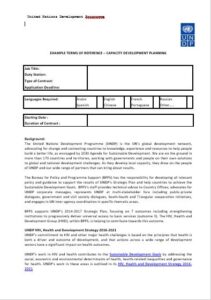
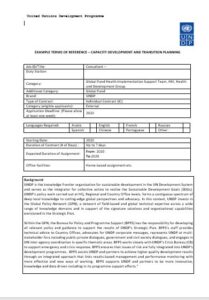
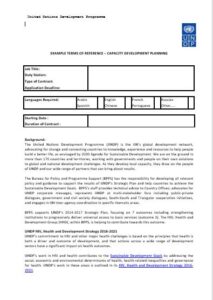
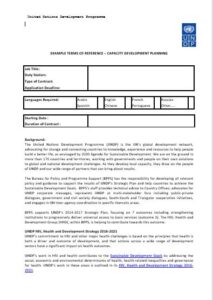
Example document and template for writing terms of reference for capacity development and transition planning
AUTHOR:UNDPLANGUAGE:EnglishFILE FORMAT:DOCX
Conducting the capacity assessment
Purpose
Successful and sustainable capacity development can only occur when there is commitment from individuals who invest in the process from the design stage onwards. Engaging stakeholders to build consensus from the time of designing the capacity development process is vital to ensure that all country partners are kept informed, consulted and engaged as necessary. Each organization will have a different role and view of the capacity development effort. UNDP works with organizations to bring country stakeholders together, along with tools to outline the scope and process for the capacity development.
In the context of programmes funded by the Global Fund to Fight AIDS, Tuberculosis and Malaria (The Global Fund), note that the capacity assessment process described here is not intended to replace the Principal Recipient assessment performed by the Global Fund. The Global Fund assessment identifies capacity gaps from the viewpoint of risk to itself, while this assessment identifies capacity needs from the viewpoint of defining plans for improvement.
UNDP’s approach
UNDP helps to convene and facilitate the stakeholders of a health programme to:
Plan the assessment: identify how the assessment will be conducted, including whether it will be conducted with or without support from an external facilitator; the type of information-gathering method used, such as group meetings, workshops and one-on-one assessment meetings; and which organizations will be involved.
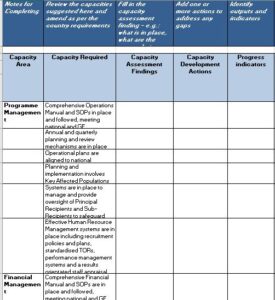
Confirm the scope of capacities to be assessed: review and update the specific skills and capacities to be assessed within each focus area. Depending on the country context, focus areas might include programme management, health information systems, procurement and supply chain management, financial management, and legal and policy environments.
Review existing documentary evidence: review and capture existing documentary evidence of current capacity from previous assessments, strategy documents and audit reports.
Conduct the assessment: capture strengths, needs and recommendations for each capacity.
Verify the assessment: review and confirm initial findings from further discussions with relevant partners and stakeholders.
Draft an assessment report if required: to consolidate the assessment results and develop draft conclusions.
Tools and guidance
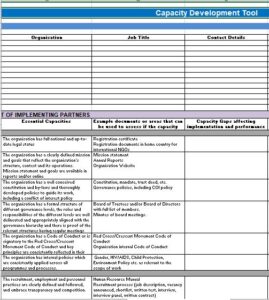
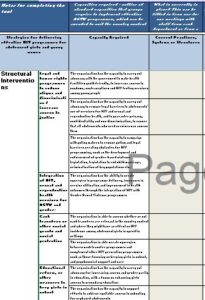
UNDP has developed a set of capacity assessment tools that are tailored to the needs of ministries of health, large organizations such as international non-governmental organizations or networks, and local civil society organization (CSO) implementing partners. UNDP has also supported capacity assessment processes tailored to specific programme components, such as interventions for adolescent girls and young women and key populations.
Key considerations for conducting an effective capacity assessment can be found here.
This comprehensive tool is designed for HIV, TB and Malaria with the main purpose to strengthen the systems and procedures of national entities to manage national programmes.
The tool is designed for assessing the capacity of potential PRs and to detail activities that need to take place before transition to a new Global Fund PR can fully...
This rapid tool is designed for HIV, TB and malaria with the main purpose to strengthen the systems and procedures of national entities to manage national programmes.
This tool is to support the capacity assessment and development of CSOs, covering programme management, monitoring and evaluation, financial management and procurement.
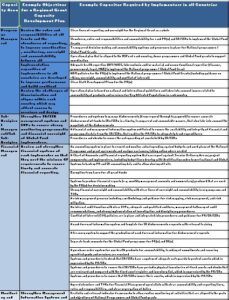
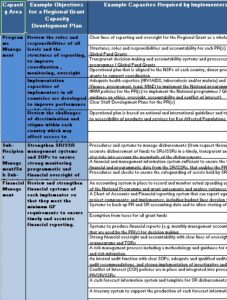
The plan outlines and prioritizes capacity development objectives, interventions and output indicators designed to enhance implementers’ capacity in multiple countries.
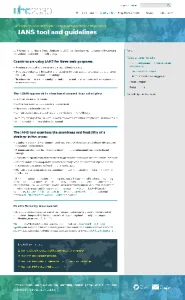
These tools & guidelines provide a shared approach to assess the strengths and weaknesses of a national health strategy or plan. JANS can support the assessment of what is required...
AUTHOR:UHC 2030LANGUAGE:EnglishFILE FORMAT:Web Link
Example document and template for writing terms of reference for capacity development and transition planning
AUTHOR:UNDPLANGUAGE:EnglishFILE FORMAT:DOCX
Drafting the Capacity Development plan
Purpose
Successful and sustainable capacity development can only occur when there is commitment from individuals who invest in the process from the design stage onwards. Engaging stakeholders to build consensus from the time of designing the capacity development process is vital to ensure that all country partners are kept informed, consulted and engaged as necessary. Each organization will have a different role and view of the capacity development effort. UNDP works with organizations to bring country stakeholders together, along with tools to outline the scope and process for the capacity development.
Once the needs of a programme and all relevant stakeholders are identified through the capacity assessment, UNDP supports the identification of capacity development activities and the development of baselines and targets to form the basis of the capacity development plan.
Identify interventions: the activities should be described in detail, noting the capacity strengths and weaknesses that have led to the proposed activity.
Define capacity development indicators: each capacity development activity should have a clear indicator to measure progress. Indicators should be relevant and feasible to measure.
Outline capacity development objectives: the plan should outline the overall objectives of groups of activities. For example, activities such as developing financial policies and procedures and training staff to effectively implement these procedures would contribute to the overall objective of strengthening financial management capacities and reducing risk. Similarly, investing in renovating storage facilities at health clinics and designing and implementing an electronic logistics management information system would contribute to the objectives of improving the supply of health products and reducing wastage.
Develop an estimated budget: Once the activities are agreed, the budget should be developed using standard costing.
Tools and guidance
UNDP has developed templates for a wide variety of capacity development plans, including for civil society organizations (CSOs), national AIDS councils, ministries of health and programmes targeting specific key populations working in HIV, which can be found below.
The following points should be considered when completing the capacity development plan:
Define appropriate indicators: defining indicators to measure changes in capacity is difficult, but they are key to measuring success. The number of indicators should be as few as possible, easily measurable, and SMART (specific, measurable, achievable, realistic and time-bound), and should consider both qualitative and quantitative progress where possible.
Identify short-term objectives: to build confidence and experience and to demonstrate results and value, it is important to schedule and plan for some short-term objectives in the capacity development plan (typically within one year). These objectives can help to guide follow-on interventions.
Aim to set long-term objectives: capacity development is a process of change, often involving multiple activities. There is a need for capacity development to be more explicitly woven into national programme management processes. In the long-term, clear objectives and milestones should be embedded into national health programmes.
Coordinate with existing strategies and plans: capacity development plans should not stand alone but should be integrated into existing national strategies and plans.
Capacity development planning with Global Fund support
The Global Fund will invest in interventions that support national strategic plans and promote alignment with programme activities. The capacity development plan can include interventions to strengthen the development of disease-specific national strategic plans and the establishment of strong links with national health strategies. Where possible, planning for a programme transition to a national entity should be done at the same time as capacity development planning, to define the desired capacity in each area, and to set measurable milestones for the transfer of responsibilities.
Interventions eligible for the Global Fund support include:
Activities that contribute to planning, developing and reviewing national health sector strategies, health systems-related strategies and sub-strategies (e.g., HRH or procurement and supply chain systems);
Developing and supporting mechanisms to supervise, monitor and report on the implementation of health sector and disease-specific laws and policies;
Activities that contribute to financing of these plans;
Activities at the local, district, regional and national levels aimed at integrated planning, programming, budgeting and financings;
HRH-related costs, such as capacity-building for policymakers.
Suggested capacity development indicators include: Existence of an up-to-date national health strategy, linked to national needs and priorities; Evidence of mid-term strategy review and updates, and final evaluation; Strategy has a supporting operational plan and is fully costed.
This comprehensive tool is designed for HIV, TB and Malaria with the main purpose to strengthen the systems and procedures of national entities to manage national programmes.
The tool is designed for assessing the capacity of potential PRs and to detail activities that need to take place before transition to a new Global Fund PR can fully...
This tool is to support the capacity assessment and development of CSOs, covering programme management, monitoring and evaluation, financial management and procurement.
The plan outlines and prioritizes capacity development objectives, interventions and output indicators designed to enhance implementers’ capacity in multiple countries.
These tools & guidelines provide a shared approach to assess the strengths and weaknesses of a national health strategy or plan. JANS can support the assessment of what is required...
AUTHOR:UHC 2030LANGUAGE:EnglishFILE FORMAT:Web Link
Example document and template for writing terms of reference for capacity development and transition planning
AUTHOR:UNDPLANGUAGE:EnglishFILE FORMAT:DOCX
Stakeholder review and finalizing the plan
Purpose
Successful and sustainable capacity development can only occur when there is commitment from individuals who invest in the process from the design stage onwards. Engaging stakeholders to build consensus from the time of designing the capacity development process is vital to ensure that all country partners are kept informed, consulted and engaged as necessary. Each organization will have a different role and view of the capacity development effort. UNDP works with organizations to bring country stakeholders together, along with tools to outline the scope and process for the capacity development.
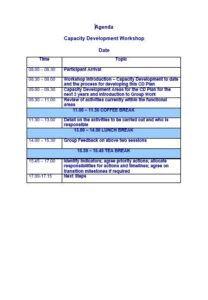
UNDP facilitates review workshops, bringing together all relevant groups, and provides template agendas to help guide the discussions. It supports the stakeholders in particular through the following actions:
Assessment verification: the assessment results and the proposed activities should be verified with appropriate stakeholders and partners.
Prioritize and schedule interventions and finalize the budget: it is important at this stage to prioritize capacity development objectives and activities, given that the available resources may not cover the full plan and that certain activities may be more crucial than others to the achievement of national strategic goals. Following the verification and the prioritization, the budget may need to be revised. Funds for capacity development management activities should be included in the overall budget. This should cover all coordination/management costs, monitoring and evaluation processes, and costs associated with the capacity development of staff.
Draft the capacity development plan report: it may be helpful at this stage to document the elements of the plan, to share with in-country partners and other donors.
Sign-off from national leaders: capacity development is nationally owned and the final approval for the plan should lie with the organization(s) being strengthened. The final approval to proceed should be obtained by the senior management of the organization(s) involved.
Launch the plan: it may be useful to hold a launch of the plan to ensure all relevant stakeholders are aware of the final focus and activities. This also contributes to the buy-in and coordination of the plan. If funds are still required (both financial and human resources) this may be an opportunity to approach donors.
Tools and guidance
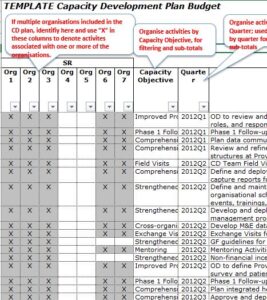
Example templates for stakeholder review workshops and capacity development plan budgets are available in the key resources section below.
The following points should be considered when carrying out the stakeholder review and finalizing the capacity development plan.
A plan is only of use if it is implemented. An important consideration of the stakeholder review is to ensure ongoing ownership and responsibility, to move the plan from the assessment and planning stage to the implementation stage. Implementation will only take place if a majority of stakeholders feel ownership towards the plan’s activities and objectives.
Supporters and resisters should be considered. In defining a plan of change for any organization, there will be supporters and adversaries; the objective should be to engage both parties in a joint effort to agree on prioritized activities.
Realistic schedules and timelines should be defined. Consideration should be given to the time required to review by all country stakeholders. In addition, obtaining funding for the plan may also take time. This can delay implementation by six months to a year after the completion of a capacity development plan.
Donors may be able to offer in-kind resources as well as financial ones. Some donors may be able to offer in-kind support instead of money; this could include providing consultants or technical experts to carry out training or mentoring, or computer hardware or software packages to improve systems.
Cross-organizational activities can help reduce costs. If multiple organizations are included within the plan, consider identifying cross-organizational activities. Often a capacity need is required by several different implementers. Sharing activities across organizations may help to reduce overall costs; for example, only one set of training tools will be required for multiple training sessions.
Monitoring the implementation of the Capacity Development plan
Purpose
Successful and sustainable capacity development can only occur when there is commitment from individuals who invest in the process from the design stage onwards. Engaging stakeholders to build consensus from the time of designing the capacity development process is vital to ensure that all country partners are kept informed, consulted and engaged as necessary. Each organization will have a different role and view of the capacity development effort. UNDP works with organizations to bring country stakeholders together, along with tools to outline the scope and process for the capacity development.
Following the launch of a capacity development plan, UNDP supports the ministry of health and other stakeholders to:
Prepare for implementation: confirm the implementation arrangements, including who will monitor the day-to-day activities, how information will be shared about results, and management roles and responsibilities.
Confirm the capacity development oversight arrangements: identify who will oversee the implementation on a quarterly or semi-annual basis.
Implement the capacity development plan and conduct regular monitoring: manage inputs and resources to implement activities and ensure regular monitoring and reporting to management and the oversight group
Adapt the plan and alter course if necessary: adjust the programme as required during implementation to better achieve results.
Evaluations of both service delivery and plans to strengthen the health system should feed back to the stakeholders involved in the programme design and implementation and to the national strategic plan to assess the programme’s contribution to national goals.
Tools and guidance
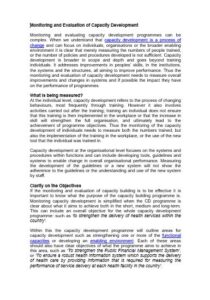
UNDP has supported the implementation of capacity development plans in countries as diverse as Zimbabwe, Afghanistan, Sudan and Zambia, working in close partnership with national entities. Based on this experience, UNDP has developed a guide to monitoring and evaluating capacity development which brings together lessons learnt and offers ideas on best practices.
The following points should be considered during implementation.
Capacity development needs can change over time. Capacity development interventions and schedules may need to be adapted, redefined and updated at many points during implementation, on account of changing needs of individuals and organizations within a changing environment. Therefore, the regular monitoring of indicators is important and the changing of plans is likely.
There should be flexibility in the management of capacity development. Because capacity development is complex, and it can be difficult to measure changes in capacity, it does not necessarily fit well within the typical project management method of measuring numbers relative to budget. The primary need is for management to critically review both quantitative and qualitative progress and assess the changes in capacity as well as any new needs that have emerged.
Strong communication on implementationis key. To improve effective communications during implementation between the various country stakeholders, a web-based knowledge sharing system can be considered to organize activity schedules, provide updates on deliverables and store reports.
Existing stakeholder bodies should be leveraged for oversight processes. In the context of the Global Fund to Fight AIDS, Tuberculosis and Malaria (The Global Fund) programmes, Country Coordinating Mechanisms (CCM) can be one of the most effective mechanisms for the oversight of implementation of capacity development plans because of their focus on national ownership and because they consist of representatives from all key sectors and constituencies within countries. Creating a culture of dialogue among the different CCM members could result in more effective and efficient delivery of capacity development measures and should promote the sharing of good practices.
Example document and template for writing terms of reference for functional review.
AUTHOR:UNDPLANGUAGE:EnglishFILE FORMAT:DOCX
Evaluating the Capacity Development plan
Purpose
Successful and sustainable capacity development can only occur when there is commitment from individuals who invest in the process from the design stage onwards. Engaging stakeholders to build consensus from the time of designing the capacity development process is vital to ensure that all country partners are kept informed, consulted and engaged as necessary. Each organization will have a different role and view of the capacity development effort. UNDP works with organizations to bring country stakeholders together, along with tools to outline the scope and process for the capacity development.
UNDP carries out both informal reviews and formal evaluations of capacity development plans and supports processes to inform learning and next steps, such as planning for follow-on.
Prepare for evaluation: confirm the scope and timing of the evaluation, organize documentation, and select the evaluation team.
Manage the evaluation: brief the evaluation team, review inception reports, and review evaluation draft reports.
Leverage evaluation results: present and disseminate the evaluation results, share lessons learned and ensure the findings are used in future planning.
Tools and guidance
The sample terms of references below outline standard duties and responsibilities for a consultant to conduct a capacity development plan evaluation. Additional guidance and good practices can be found in the document “Monitoring and Evaluation of Capacity Development”.
The following points should be considered when evaluating a capacity development intervention.
Use existing data and information. Evaluations should use information available from a variety of sources, such as reports from other donors on their support to programmes organizations.
Integrate capacity development evaluations. Conducting evaluations of capacity development initiatives are no different to carrying out any other evaluation. Therefore, where possible, capacity development evaluations should be integrated with programme evaluations.