UNDP's commitment to addressing HIV and other major health and development challenges is based on the principles that health is a driver for and an indicator and outcome of development.
As outlined in the UNDP Strategic Plan 2022-2025, UNDP’s support to countries aims to eradicate poverty in all its forms and dimensions, accelerating structural transformation for sustainable development and supporting governments to build resilience to shocks and crises.
UNDP defines capacity development as the process through which individuals, organizations and societies obtain, strengthen and maintain the capabilities to set and achieve their own development objectives over time.
Strong partnerships are the cornerstone of UNDP's work to strengthen systems for health. In its support to countries UNDP works closely with other United Nations entities, development organizations, civil society organizations, the private sector, academia and key populations to develop resilient and sustainable systems for health.
The effectiveness of UNDP's model of health programme support, with its emphasis on end-to-end capacity development, is evident in the results of its long-standing partnership with the Global Fund to Fight AIDS, Tuberculosis and Malaria (the Global Fund).
Whether in its role as an implementing partner managing large-scale HIV, TB, and malaria programmes funded by the Global Fund or as a technical assistance
Investments in resilient and sustainable systems for health lay the foundation for the effective and equitable delivery of HIV, tuberculosis (TB) and malaria.
Human rights barriers include stigma and discrimination, punitive laws, policies and practices, violence, harassment, gender, and social and economic inequalities.
People most affected by HIV, tuberculosis (TB) and malaria are often the same people who are marginalised and have limited or no access to health care.
Gender equality is essential to achieving health and well-being for all, accelerate progress towards the health-related Sustainable Development Goal (SDG) targets and ensuring that no one is left behind.
Despite longstanding efforts and significant investments, the world remains off -track for achieving the Sustainable Development Goal target of ending malaria by 2030. Malaria persists where sustainable development is slowest. Countries with a high malaria burden experience a 1.3% annual loss in economic growth, and their GDP per capita grows up to five times more slowly than in countries with little or no malaria. Inverting the vicious cycle requires new, integrated ways of collaborating; and thinking holistically about development and comprehensive multisectoral action is essential. Conventional malaria interventions are faced with a system challenge. In many settings, the root causes of malaria extend beyond the confines of the healthcare sector, reaching into realms such as social and economic inequities, poor housing, environmental degradation, agricultural practices, and water and waste management. Yet, the global response to malaria has traditionally centered on the health sector and vector control, often neglecting the broader determinants of the disease.
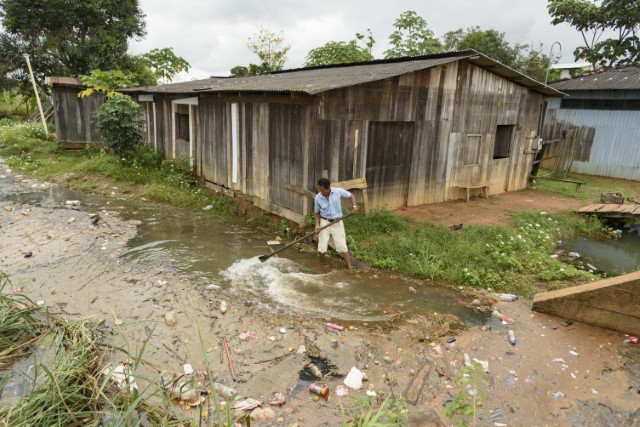
Man cleans a creek of debris outside his house in the town of Guayaramerín, Bolivia, where there are outbreaks of malaria, and periodic flooding brings an increase in mosquitoes.Photo: UNDP Bolivia/Miguel Samper
Using data, case studies and practical tools, the Comprehensive Multisectoral Action framework provides guidance for policymakers, programme managers and funders to adapt their approaches to addressing malaria. This framework advocates a shift from a health-sector-centric approach to a comprehensive, coordinated, and multisectoral response. It aims to harness integrated action, commitment, and expertise across key sectors to combat malaria effectively.
Tools and Examples
Pathfinding for Comprehensive Multisectoral Action Tool
The Pathfinder Endeavour is a collaboration between UNDP, WHO, UN-Habitat, the Roll Back Malaria Multisectoral Working Group and others. It aligns directly with UNDP’s Strategic Plan for 2022-2025, emphasizing collaboration across the revitalized UN-system to achieve transformative change.
To achieve the goals of malaria elimination, improved population health, and reduced inequities concerted simultaneous actions across multiple sectors and all SDGs are necessary. This comprehensive multisectoral approach encompasses political, institutional, social, economic, environmental, climatic, and health-related factors that intersect to drive the vicious cycle of malaria. It recognizes that addressing these multifaceted issues calls for collaboration that transcends individual sector interests. It also promotes political, technical, and public accountability through direct and real-time engagement with citizens.
Through this approach, Pathfinder helps unlock synergies and co-benefits across multiple sectors, transforming malaria elimination into a shared responsibility rather than a health-sector-only concern. While selective multisectoral action has been common, there is no universal blueprint for fully integrated efforts. To bridge this gap, the Pathfinder accelerates progress by learning from real-life cases, focusing on areas and populations that are furthest behind, and identifying new ways to collaborate around shared co-benefits that complement existing structures and resources. This comprehensive, multisectoral view is essential to breaking the cycle of malaria and poverty, ensuring that global health goals and sustainable development objectives are achieved in tandem.
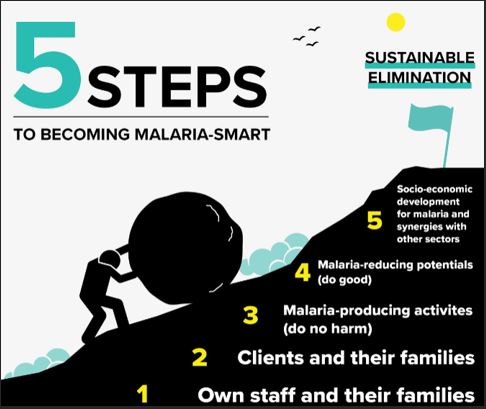
The Pathfinder Endeavour provides a structured process for sustainable results on the ground in real-life situations. The onus is on local systems, governments, and communities in four initial countries with three districts in each that are among the furthest behind in malaria elimination and in achieving the SDGs. The process fosters cross-learning with international peers through the five-step path to becoming malaria-smart, ensuring interventions align with existing structures and resources. Over four phases spanning three years, it facilitates exploration, hands-on experience, and systematic documentation of innovative approaches, paving the way for sustainable results, scale-up, and replication. As of April 2025, the initiative has entered the pre-project phase in four countries – Madagascar, Uganda, Cameroun, and Ghana.
Example of Multisectoral Action
Malaria and poverty are intricately linked, with nearly half of households in malaria-prone areas spending over 40% of their income on healthcare, pushing billions deeper into poverty. Despite new vaccines, progress in reducing cases has stalled, and climate change, conflict, and displacement are worsening the situation. Countries like Sri Lanka, Azerbaijan, and Tajikistan have shown that integrating sustainable development practices with malaria interventions—such as improving living conditions and water management—can drive success. UNDP, alongside key partners, is promoting a multisectoral approach that addresses the root causes of malaria while advancing health, economic, and social development. To meet global targets by 2030, bold, integrated actions and increased funding are essential to create a malaria-free and more equitable world.