UNDP's commitment to addressing HIV and other major health and development challenges is based on the principles that health is a driver for and an indicator and outcome of development.
As outlined in the UNDP Strategic Plan 2022-2025, UNDP’s support to countries aims to eradicate poverty in all its forms and dimensions, accelerating structural transformation for sustainable development and supporting governments to build resilience to shocks and crises.
UNDP defines capacity development as the process through which individuals, organizations and societies obtain, strengthen and maintain the capabilities to set and achieve their own development objectives over time.
Strong partnerships are the cornerstone of UNDP's work to strengthen systems for health. In its support to countries UNDP works closely with other United Nations entities, development organizations, civil society organizations, the private sector, academia and key populations to develop resilient and sustainable systems for health.
The effectiveness of UNDP's model of health programme support, with its emphasis on end-to-end capacity development, is evident in the results of its long-standing partnership with the Global Fund to Fight AIDS, Tuberculosis and Malaria (the Global Fund).
Whether in its role as an implementing partner managing large-scale HIV, TB, and malaria programmes funded by the Global Fund or as a technical assistance
Investments in resilient and sustainable systems for health lay the foundation for the effective and equitable delivery of HIV, tuberculosis (TB) and malaria.
Human rights barriers include stigma and discrimination, punitive laws, policies and practices, violence, harassment, gender, and social and economic inequalities.
People most affected by HIV, tuberculosis (TB) and malaria are often the same people who are marginalised and have limited or no access to health care.
Gender equality is essential to achieving health and well-being for all, accelerate progress towards the health-related Sustainable Development Goal (SDG) targets and ensuring that no one is left behind.
Implementation driven by country ownership and Capacity Development
The effectiveness of UNDP’s model of health programme support, with its emphasis on end-to-end capacity development, is evident in the results of its long-standing partnership with the Global Fund to Fight AIDS, Tuberculosis and Malaria (the Global Fund).
UNDP has partnered with the Global Fund since 2002 to support and strengthen national responses to HIV, tuberculosis (TB) and malaria, assisting countries to implement large-scale health programmes, including reaching some of the most hard-to-reach populations, and strengthening institutions' ability to deliver essential services in challenging and high-risk country contexts. UNDP is managing 29 Global Fund grants, covering 21 countries and 2 Regional Programmes. This totals to a signed grant amount of US$ 1,498,417,869 for UNDP's Global Fund portfolio.
While acting as the interim PR, UNDP develops national capacity and strengthens national systems with the aim of transferring the role of PR to national entities when circumstances permit. UNDP also strengthens local organisations within countries to enhance their capacities for grant implementation activities. Additional information on the focus areas of the UNDP-Global Fund partnership, along with guidance and resources for UNDP and partners’ implementation of the Global Fund and other health programmes, can be found in the online UNDP-Global Fund and Health Implementation Guidance Manual
UNDP areas of focus
With its particular expertise and experiences, UNDP’s focus within the partnership includes:
Promoting country ownership of Global Fund programmes
UNDP supports countries in aligning their Global Fund applications with national disease and health strategies, and also more broadly helps countries with their national development and poverty reduction strategies. It also engages countries in a strategic dialogue about the sustainable financing of health programmes, especially middle-income countries, where the Global Fund support will eventually be phased out.
Strengthening resilience in crisis countries and fragile states
Over the years of its partnership with the Global Fund, UNDP has become a leader in implementing health programmes in the most difficult crisis contexts and the worst conflict-affected countries. It has managed the Global Fund grants in Iraq, Mali, Syria, South Sudan, Afghanistan and other countries in crisis. In Iraq and Syria, where UNDP served as interim Principal Recipient (PR) before transitioning out of this role in 2016, it was able to reach tuberculosis patients in areas controlled by the Islamic State of Iraq and al-Sham (ISIS) and other contested areas. Under the Global Fund Development Continuum Working Group, UNDP chaired a sub-working group focusing on operating in challenging environments. UNDP also supported governments in Ebola-affected countries in adjusting their Global Fund programmes. UNDP connects the Global Fund work with its early recovery mandate in crisis and post-crisis countries.
Promoting human rights and gender equality, and serving key populations
In line with its current strategy, the Global Fund is accelerating its efforts to operationalize its commitments on human rights and gender equality, and reaching key populations. UNDP supports the Global Fund to translate these commitments into action. It also leverages its role as PR to advocate for the removal of human rights and gender barriers to enable key and vulnerable populations to access services. It does so by, for example, providing policy and technical support in areas of its expertise and mandate, including on human rights, HIV and the law, and gender equality, and by strengthening community systems.
Enhancing the sustainability of health initiatives
UNDP is uniquely positioned to promote environmental sustainability through health programme and policy efforts, including through innovative initiatives that embed sustainability into procurement practices and promote the use of clean energy, while also reducing the carbon footprint of health facilities and enhancing their ability to withstand the effects of climate change.
A support model that centers on capacity development
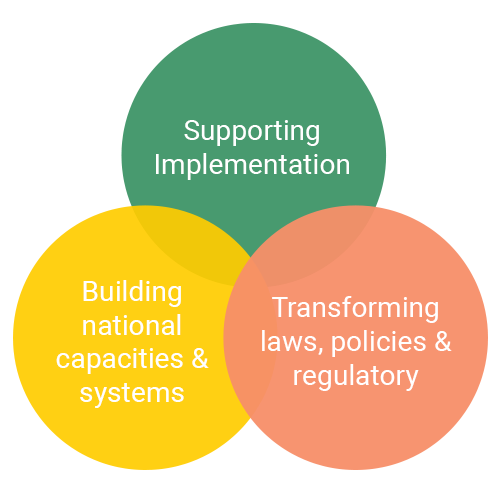
UNDP operates strictly in support, and within the framework, of national health plans and disease-specific national strategies, under the programmatic leadership of national health authorities and by supporting the crucial engagement of civil society and the private sector. Promoting national ownership, developing capacity and strengthening national systems are the overriding objectives of UNDP’s engagement – whether as an interim Principal Recipient of a Global Fund grant, a co-Principal Recipient with a national entity or a technical assignment provider to the Government. This flexibility in partnership modalities allows UNDP to provide a continuum of support tailored to local capacities and the development stage of a country. See examples of UNDP’s partnership support models here.
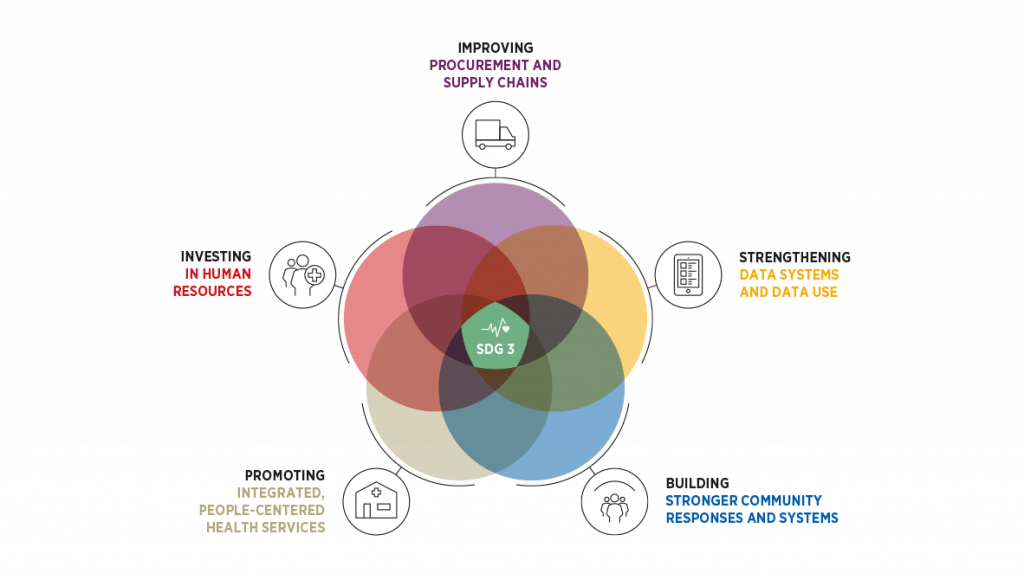
UNDP’s emphasis on and approach to capacity development aligns with the Global Fund’s strategic priorities for cross-cutting investments in health systems, responsive to the needs and constellation of partners in each country. This includes, in particular, a focus on human resources, procurement and supply chain systems, data systems and use, community systems and the promotion of integrated health services, along with other areas of work that catalyse positive multiplier effects across systems for health.
The Global Fund: pathways to end HIV, tuberculosis and malaria and achieve Sustainable Development Goal 3
Building capacities across borders: Multi-country programmes
In addition to country grants, UNDP manages several multi-country programmes through the support of the Global Fund, which invests in multi-country approaches across a number of priority areas deemed critical to HIV, tuberculosis (TB) and malaria responses. These programmes focus on cross-cutting issues that are more effectively addressed across multiple countries, such as tackling human rights barriers for key populations and ensuring access to services for migrant and refugee populations.
Cumulatively, UNDP has managed five Global Fund multi-country grants as PR since 2002, covering 39 countries. This included the Africa Regional Grant on HIV: Removing Legal Barriers until 2019, which supported 10 African countries to strengthen the legal and policy environment to reduce the impact of HIV and TB on key populations, including through regional policies and mechanisms. The Lessons Learned report on the Africa Regional Grant and other multi-country key population programmes underlines the unique contribution of regional and multi-country approaches to strengthening the capacities of civil society organizations and other key stakeholders to remove human rights barriers to HIV and TB services for key populations.
UNDP also manages a regional programme to address the cross-border challenge of TB and migration in South Asia working closely with national governments and other partners including the World Health Organization (WHO), the Stop TB partnership, the Office of the United Nations High Commissioner for Refugees (UNHCR) and the International Organization for Migration (IOM). Through a multi-country Global Fund grant (2022-2024), UNDP supports the provision of TB prevention, care and treatment services for migrants, refugees and returnees in Afghanistan, Iran and Pakistan. This involves working closely with refugee, migrant and returnee communities in all three countries to train community health workers, to ensure communities are involved in programme decisions and to develop information, education and outreach programmes that are delivered in ways that people can access and understand. Multisectoral, multi-country and concerted efforts are required to address the complex nature of mobility and instability among refugees, migrants and returnees, and the development of a regional approach to policies and practices is required to enable programmes to increase TB case detection and treatment success rates. Read more here.