UNDP's commitment to addressing HIV and other major health and development challenges is based on the principles that health is a driver for and an indicator and outcome of development.
As outlined in the UNDP Strategic Plan 2022-2025, UNDP’s support to countries aims to eradicate poverty in all its forms and dimensions, accelerating structural transformation for sustainable development and supporting governments to build resilience to shocks and crises.
UNDP defines capacity development as the process through which individuals, organizations and societies obtain, strengthen and maintain the capabilities to set and achieve their own development objectives over time.
Strong partnerships are the cornerstone of UNDP's work to strengthen systems for health. In its support to countries UNDP works closely with other United Nations entities, development organizations, civil society organizations, the private sector, academia and key populations to develop resilient and sustainable systems for health.
The effectiveness of UNDP's model of health programme support, with its emphasis on end-to-end capacity development, is evident in the results of its long-standing partnership with the Global Fund to Fight AIDS, Tuberculosis and Malaria (the Global Fund).
Whether in its role as an implementing partner managing large-scale HIV, TB, and malaria programmes funded by the Global Fund or as a technical assistance
Investments in resilient and sustainable systems for health lay the foundation for the effective and equitable delivery of HIV, tuberculosis (TB) and malaria.
Human rights barriers include stigma and discrimination, punitive laws, policies and practices, violence, harassment, gender, and social and economic inequalities.
People most affected by HIV, tuberculosis (TB) and malaria are often the same people who are marginalised and have limited or no access to health care.
Gender equality is essential to achieving health and well-being for all, accelerate progress towards the health-related Sustainable Development Goal (SDG) targets and ensuring that no one is left behind.
As outlined in the UNDP Strategic Plan 2022-2025, UNDP’s support to countries aims to eradicate poverty in all its forms and dimensions, accelerating structural transformation for sustainable development and supporting governments to build resilience to shocks and crises. UNDP partners with governments, including ministries of planning, development and finance, and with law-making bodies, civil society organizations, the private sector, citizens and other key stakeholders to achieve the Sustainable Development Goals (SDGs) and fulfil the pledge to leave no one behind.
Health plays a central role in achieving the Sustainable Development Goals and is both a precondition and an outcome of sustainable development.” – Achim Steiner, UNDP Administrator
UNDP’s commitment to addressing HIV and other major health and development challenges is based on the principles that health is a driver for and an indicator and outcome of development, and that actions across a wide range of development sectors have a significant impact on health outcomes. As a development agency, UNDP focuses on addressing the social, economic, legal, commercial and environmental determinants of health. It embraces a human rights-based approach and looks through a gender equity lens to address the underlying drivers of health inequities. UNDP’s efforts to strengthen systems for health are guided by its emphasis on supporting countries to attain universal health coverage, an important target under SDG 3 (healthy lives and well-being for all) to advance health outcomes and equity.
UNDP’s work on HIV and health is carried out in close collaboration with a broad range of partners across development sectors, including governments, civil society organizations, United Nations entities and other intergovernmental organizations, multilateral and bilateral donors, development banks, academia, the private sector and other development partners.
UNDP’s HIV and Health Strategy 2022-2025
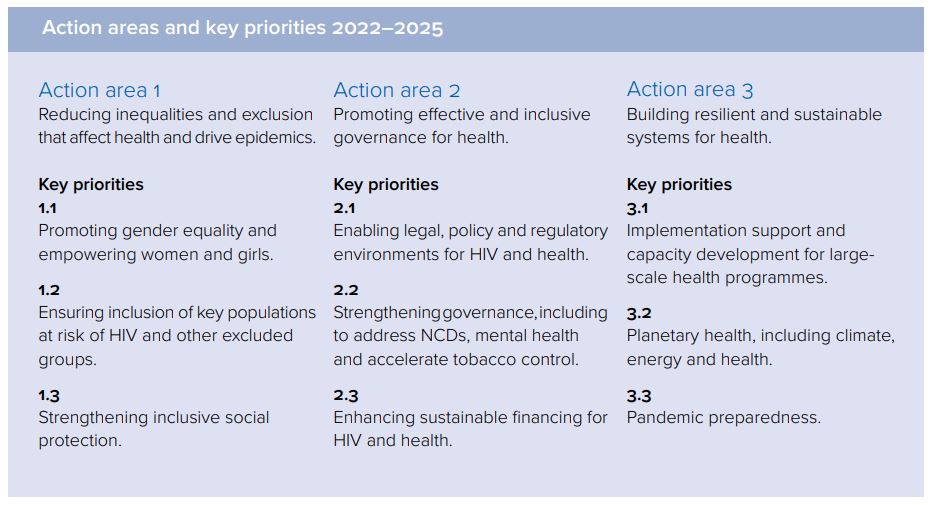
The UNDP HIV, Health & Development Strategy 2022-2025 Connecting the dots: Towards a more equitable, healthier and sustainable future outlines UNDP’s unique contribution to health through its interconnected efforts to 1) reduce the inequalities and social exclusion that affect health and drive epidemics; 2) promote effective and inclusive governance for health; and 3) build resilient and sustainable systems for health. This work is undertaken by an integrated team operating at global, national, regional and local levels.
A key channel for UNDP’s efforts to build resilient and sustainable systems for health is its support to national governments to implement large-scale health programmes in challenging, complex and high-risk country contexts (Action area 3.1). UNDP currently supports programme and policy interventions to strengthen systems for health in over 60 countries. This includes the implementation of HIV, tuberculosis (TB) and malaria grants funded by the Global Fund to Fight AIDS, Tuberculosis and Malaria (The Global Fund) in 22 countries and two regional programmes that cover an additional 11 countries in 2021. In other countries, based on demand, UNDP provides direct support to national partners for the implementation of health programmes and the strengthening of systems, such as capacity-building to strengthen national institutions or support health procurement.
Resilient systems for health are needed more than ever where conflicts and crises persist and where natural disasters are most prone to strike. A targeted approach ensures that the most vulnerable are reached. UNDP continues to work with governments and civil society organizations to help focus on the areas of most need or where epidemics present a public health concern. More investments in strengthening health and community systems will ensure that those most in need receive vital assistance.
UNDP’s role as an integrator
The breadth of UNDP’s expertise and country presence puts it in a unique position within the United Nations Development System and global health landscape to help countries “connect the dots” on some of the most complex health and development issues. It is well placed to support countries in tackling the interconnected underlying determinants affecting health and well-being.
All UNDP support for the implementation of HIV, TB, malaria and health programmes is complemented by the capacity development of national institutions and implementing partners, coupled with engagement at the policy level to create enabling environments. These efforts contribute to and draw on UNDP’s health and development expertise. For example, as part of promoting effective governance, technical support to promote anti-corruption, transparency and accountability within the health sector, in partnership with the Global Fund, the World Health Organization (WHO) and others, forms part of UNDP’s support to strengthen the capacity of systems for health.
All UNDP support for the implementation of HIV, TB, malaria and health programmes is also underpinned by efforts to ensure sustainability, including a focus on environmental sustainability. UNDP’s work on planetary health brings together efforts on climate action, with health programming to offer win-win solutions for the health of people and the planet. For example, UNDP supports innovative initiatives to embed sustainability into health procurement supply chains and promotes the use of clean energy to reduce the carbon footprint of health facilities