Purpose
Civil society groups in many countries have experienced a changing environment in terms of HIV and health care over the last few years, which has resulted in more centralized implementation by national ministries of health, stronger and different treatment approaches to HIV and other disease programmes, and a subsequent reduction in funding for civil society groups.
There is a need for civil society to review and redefine its role, both in response to HIV and to other emerging health priorities. For example, as people living with HIV live longer on treatment, they are more likely to develop a non-communicable disease such as cancer.
As governments provide the majority of treatment, civil society groups need to assess what their role is in supporting health programme implementation, such as adherence to treatment, supporting marginalized and key populations to enable access to both prevention and treatment, and advocating for policy change to reach universal health coverage (UHC) and ensure rights-based service delivery. There is a need to define and clarify civil society organizations’ new role in supporting the achievement of the goals of the Global AIDS Strategy 2021–2026, expand their role in the move to a more coordinated health and HIV approach, focus on the achievement of UHC, and develop the capacity of networks of civil society groups to strengthen their voice and advocacy role. There is also a need to assess the overall structure of civil society, asking if groups should consolidate or work more in networks to increase their power to advocate and consolidate operational costs.
UNDP’s approach
UNDP, in collaboration with the Joint United Nations Programme on HIV/AIDS (UNAIDS) and other United Nations agencies, supports civil society organizations (CSOs) to define their strategic direction within national HIV, tuberculosis and malaria responses and address capacity gaps that hinder their objectives. UNDP can, additionally, support countries to map the landscape of registered civil society and community-based organizations engaged in HIV/AIDS and other health responses in a country and support the development of cohesive networks. This might include activities to:
- formulate a strategic direction by supporting the establishment of a civil society organization (CSO) strategic priority action plan or charter
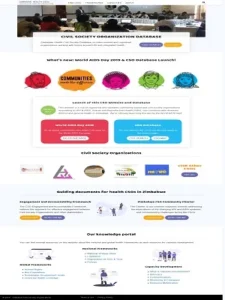
- bring visibility to registered and validated CSOs by developing an open-source website and database of HIV and health-related CSOs in a country
- support dissemination of information on how CSOs can support the move to more comprehensive health programming, integrating HIV within the broader health agenda
Tools and examples
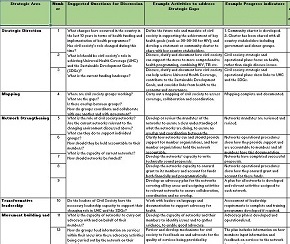
UNDP has developed and tested a tool to support civil society in carrying out in-depth discussions on what the role of civil society organizations has been and what changes have taken place in the health landscape. It offers guidance for discussion on how civil society organizations can assess what their new role should be, how this new role can be operationalized and what skills they need to carry out this role.
The tool includes:
- a set of questions to guide discussions
- example activities to support changes in strategic direction possible indicators to measure progress
- a template to budget for these activities.
For additional resources on UNDP’s work to empower civil society organizations in national disease responses with public funding, visit the "Social contracting for effective service delivery under domestically funded health programmes" page.
Empowering civil society organizations in Cuba to support the transition from a donor- to a domestic-funded HIV response
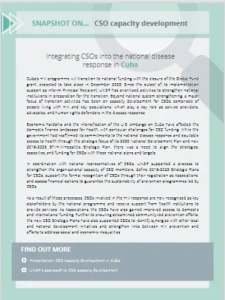
Cuba’s HIV programme was expected to transition to national funding with the closure of the Global Fund to Fight AIDS, Tuberculosis and Malaria (The Global Fund) grant in December 2020. Since the outset of its implementation of support as interim Principal Recipient of the HIV grant, UNDP has prioritized activities to strengthen national institutions in preparation for the eventual transition to government. A major focus of transition activities has been on capacity development for civil society organizations (CSOs) comprising people living with HIV and key populations. CSOs play a key role as service providers, advocates and human rights defenders in the disease response. There was a need in particular to align the strategies, capacities and funding for CSOs with existing national plans and targets in relation to HIV.
In coordination with national representatives of CSOs, UNDP supported a process to strengthen the organizational capacity of CSO members, define the 2019–2023 strategic plans for CSOs, facilitate the formal recognition of CSOs through their registration as associations and assess financial options to guarantee the sustainability of prevention programmes led by CSOs. As a result of these processes, CSOs involved in the HIV response are now recognized as key stakeholders by the national programme and receive support from health institutions to provide services. The CSO strategic plans have also supported CSOs to identify synergies with other local and national development initiatives and strengthen links between HIV prevention and efforts to address social and economic inequalities. While Cuba was eventually declared eligible again for another Global Fund allocation, and is not transitioning to domestic funding yet, the work completed to strengthen CSOs will help put Cuba in a good position to do so when the time comes.
Case study: strengthening civil society coordination for enhanced engagement in the HIV response in Zimbabwe
The evolution of the HIV epidemic and centralization of the response in Zimbabwe over the past decade has meant reduced funding availability for HIV and AIDS service community-based and civil society organizations (CSOs). As part of a comprehensive nationally owned capacity development strategy for 2018–2020 to strengthen systems for health, UNDP, the Joint United Nations Programme on HIV/AIDS (UNAIDS) and the United Nations joint team in Zimbabwe facilitated consultations with HIV-related CSOs in the country to clarify their roles in supporting the achievement of the 90–90–90 targets and gain an understanding of the capacities needed to expand their engagement. A major focus included the need to strengthen coordination across organizations as a means of enhancing their collective impact. Based on a CSO strategic priority action plan developed with the engagement of CSOs, a number of activities were prioritized to improve governance structures for the coordination of CSOs and to enhance their relevance and sustainability in contributing to the HIV response.
Key outcomes included the establishment of the CSO Community Charter launched in February 2019, the accompanying CSO Engagement and Accountability Framework, and training for 180 CSO members on these documents. UNDP also led a mapping exercise of all CSOs working in the health and HIV sectors in 2019, which resulted in the creation of a public database of 150 CSOs. The CSOs selected the Zimbabwe AIDS Network (ZAN) to serve as their umbrella organization, to be guided by a set of standard operating procedures currently under development. These efforts have contributed to greater coordination of CSOs under a unified framework, with a strategic direction for their role in the HIV and health response and a strong basis for resource mobilization efforts.
Case study: working with community groups to reach pregnant women with HIV in Angola
In partnership with the National Institute to Fight HIV/AIDS in Angola and the Global Fund to Fight AIDS, Tuberculosis and Malaria (The Global Fund), UNDP works with local networks and community groups to help reach more pregnant women living with HIV, with the overall goal of ensuring that all babies are born free of HIV. UNDP has worked with partners to support the development of the national plan for eliminating mother-to-child transmission of HIV, entitled Born Free to Shine, which is headed by Angola’s First Lady, Ana Dias Lourenço. Read more