UNDP's commitment to addressing HIV and other major health and development challenges is based on the principles that health is a driver for and an indicator and outcome of development.
As outlined in the UNDP Strategic Plan 2022-2025, UNDP’s support to countries aims to eradicate poverty in all its forms and dimensions, accelerating structural transformation for sustainable development and supporting governments to build resilience to shocks and crises.
UNDP defines capacity development as the process through which individuals, organizations and societies obtain, strengthen and maintain the capabilities to set and achieve their own development objectives over time.
Strong partnerships are the cornerstone of UNDP's work to strengthen systems for health. In its support to countries UNDP works closely with other United Nations entities, development organizations, civil society organizations, the private sector, academia and key populations to develop resilient and sustainable systems for health.
The effectiveness of UNDP's model of health programme support, with its emphasis on end-to-end capacity development, is evident in the results of its long-standing partnership with the Global Fund to Fight AIDS, Tuberculosis and Malaria (the Global Fund).
Whether in its role as an implementing partner managing large-scale HIV, TB, and malaria programmes funded by the Global Fund or as a technical assistance
Investments in resilient and sustainable systems for health lay the foundation for the effective and equitable delivery of HIV, tuberculosis (TB) and malaria.
Human rights barriers include stigma and discrimination, punitive laws, policies and practices, violence, harassment, gender, and social and economic inequalities.
People most affected by HIV, tuberculosis (TB) and malaria are often the same people who are marginalised and have limited or no access to health care.
Gender equality is essential to achieving health and well-being for all, accelerate progress towards the health-related Sustainable Development Goal (SDG) targets and ensuring that no one is left behind.
Storage facilities should be compliant with the pharmaceutical good storage practices to ensure stock security and to preserve the quality, efficacy and safety of medicines and other health products throughout the supply chain until it reaches the end users. In addition, storage includes a set of activities performed by qualified personnel, from products reception, inventory management to dispatch for distribution to subsequent service delivery points.
Requirements for good storage from central to peripheral level include:
a facility with adequate storage and working space for its intended use as well as infrastructure components that will protect commodities from harmful environmental conditions and diversions.
application of adequate inventory management procedures so that commodities are always available, accessible, in good condition, and pose no risk of injury to workers;
availability of timely and accurate inventory data for informed decision-making;
qualified human resources in sufficient quantity to meet operational needs.
Source: John Snow, Inc. (2017). The Supply Chain Manager’s Handbook.
UNDP’s approach
UNDP has expertise in the assessment of national supply chains with the identification of needs and their prioritization. UNDP can offer support in the development of supply chain strategies and in infrastructure projects to address storage and supply chain needs from the central to peripheral levels.
UNDP’s Solar for Health Initiative is used to build additional resilience and connectivity in the supply chain, equipping warehouses and health facilities with solar panels and therefore ensuring electricity for cold chain, controlled temperature storage and computer-based electronic warehouse management systems and logistics management information systems. As part of its Smart Facilities initiative, UNDP also offers a range of other digital solutions to strengthen the sustainability and efficiency of infrastructure. It likewise draws on technical solutions implemented in other sectors, including those identified through the UNDP-Singapore Global Centre for Technology, Innovation and Sustainable Development
Overall support is provided through expert advice in areas such as:
the development of quality assurance and good storage practices training programmes;
the procurement and calibration of temperature recording loggers;
the procurement and installation of cooling units;
the development of self-inspection programme;
the support to outsource storage and distribution to a service provider for storage and distribution.
Examples
Over the years, UNDP has participated in various projects devoted to improving inventory management and storage conditions of health products.
Supply chain assessments
Sustainable and resilient health systems require a functional supply chain system, including the adequate management of central-, regional- or district-level stores. UNDP has been involved in supporting the assessment of national supply chains systems, including in Chad, Equatorial Guinea, Sudan, Tajikistan, Zambia and Zimbabwe.
Supply chain strategies
In some countries, UNDP has also taken an active role in the development of supply chain strategies under the leadership of the national authorities and in facilitating the collaboration of supply chain partners, such as in South Sudan, Sudan and Burundi. Such strategies are critical to defining priorities among the identified needs, establishing work plans and related budgets, coordinating inputs from different partners and optimizing available resources to strengthen the national supply chain.
Health infrastructure works
UNDP has a track record of experience in managing infrastructure projects to improve storage capacity and conditions. In particular, UNDP has conducted extension of storage capacity projects at different levels of the supply chain (central, regional, peripheral) in numerous countries.
These projects have included support to build a new national warehouse Guinea-Bissau and renovate a malaria products warehouse in Bolivia. In Sudan, Kyrgyzstan and Turkmenistan, UNDP has provided support to strengthen national warehousing and to equip and renovate storage facilities at different levels of the supply chain for pharmaceutical and other health products. All infrastructural/warehousing projects are considered holistically and are often coupled with the provision of equipment (e.g. shelves, pallets, forklifts, ventilation/air-conditioning systems, warehouse management information systems) to ensure good storage conditions in terms of temperature, humidity, cleanliness, pest control and light exposure and stock security.
As a part of this comprehensive offer, UNDP has also installed solar panels on medical warehouses in Angola, Sudan, Zambia and Zimbabwe, among other countries, to ensure continued power supply for cold chain equipment and controlled temperature storage conditions.
Infrastructure projects are combined with capacity development in the implementation of good storage practices, related to personnel, premises and facilities, storage requirements, returned goods, dispatch and transport, and product recall. For example, technical assistance on storage and inventory management at the central level has been provided in Guinea-Bissau and South Sudan. As an interim Principal Recipient of the Global Fund to Fight AIDS, Tuberculosis and Malaria grants in some countries, UNDP country office specialist(s) systematically participate in national technical procurement and supply chain management working groups involved in the monitoring of health product stock levels and supply chain strengthening.
Case Study: Resilience and Sustainable Infrastructure for Stronger Supply Chains in Mozambique
In 2019, UNDP began supporting Mozambique’s Ministry of Health (MoH) with health infrastructure development to improve the storage of medicines and health products and the disposal of medical waste, under the National Logistics Pharmaceutical Plan. Through a financing agreement under the Global Fund HIV and tuberculosis grant, UNDP and the MoH established and renovated central and regional medical warehouses.
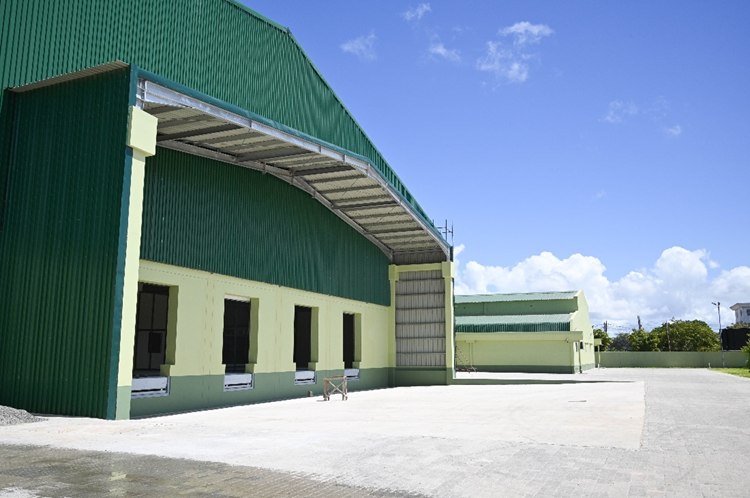
The Chimoio regional warehouse was inaugurated in July 2021 to provide a secure storage and distribution point and consistently supply quality medicines and health products in Manica province, including at the last mile. The warehouse serves 139 Health Facilities covering a population of about 2,298,753 in the Manica province (Source: Centre for Medicines and Medical Products, CMAM). This fully equipped, 2,278 m2 warehouse was also the first in Mozambique to install a containerized incinerator to manage biomedical waste. In June 2023, UNDP and the MoH reopened the Beira Central Warehouse in Sofala province, which was damaged by Cyclone Idai in 2019. This warehouse can withstand winds of up to 200 km/h. The initiative increases access to quality health products in remote areas affected by disasters, as part of UNDP’s broader work to promote inclusion, resilience and sustainability.
Photo: Beira Central Warehouse, after renovation in March 2023
Operated by CMAM, the Beira Central Warehouse supplies 4 provinces in the Central Region of the country: Sofala, Manica, Tete and Zambezia. This includes supplying the Central Hospitals of Beira and Quelimane cities, serving 187 Health Facilities and covering a population of approximately 2,674,787 in these provinces (Source: CMAM). The warehouse includes:
A maximized and optimized racking system with more than 5,000 pallets
Flexi stackers for improved product handling and storage management
Enhanced security systems with up-to-date computer, data, and security systems
An 800% increase in electricity production, up to 1000 kVA, providing a reliable source of power.
Storage capacity of 42 m3 of clean water and 36 m3 of rainwater for the operation and maintenance of the facility’s safety.
In recent years, UNDP Mozambique has established new partnerships with the Islamic Development Bank to expand health centres in response to COVID-19. UNDP Mozambique is also working alongside the MoH and Gavi, the Vaccine Alliance to strengthen waste management policies. Discussions have started to provide options for the establishment of Smart Facilities for Health at various points of the supply chain in the coming years, which would improve the sustainability and reliability of health services.
Case study: Transforming NatPharm Warehouse to Strengthen Healthcare in Zimbabwe
The newly commissioned NatPharm warehouse in Masvingo, Zimbabwe, funded by the Global Fund and supported by UNDP, marks a significant improvement in healthcare delivery. The US$3.66 million facility will enhance the storage and distribution of medicines to over 250 health institutions across the province. Equipped with solar power and modern handling systems, the warehouse will help address supply chain inefficiencies and improve access to life-saving treatments for HIV, TB, and malaria. This project is part of the ongoing Resilient Systems Strengthening for Health (RSSH) initiative, which has seen $30 million invested in improving Zimbabwe’s health infrastructure.