Overview
Anti-corruption, transparency and accountability measures are central components of health systems strengthening for universal health coverage.
Corruption in the health sector diverts resources, leads to negative health outcomes, threatens people’s lives and undermines citizen trust in public institutions. It also reduces the quality of health services and products, increases their costs, limits access to them, causes waste of financial and non-financial resources, leads to poorer staffing, and human rights violations and aggravates inequities. According to Transparency International, corruption in the health sector causes losses of over $500 billion every year, more than the amount of resources needed for universal health coverage. In 2018, the World Bank estimated that in some countries, as much as 80 per cent of non-salary health funds do not reach health facilities because of corruption. The poorest and most vulnerable populations in society are ultimately the ones to suffer the consequences.
Corruption in the health sector can take several forms. Transparency International defines six in particular. 1) Informal payments from patients; 2) embezzlement and theft; 3) absenteeism; 4) corrupt service provision activities, such as overcharging and false treatment reimbursement claims; 5) favouritism; and 6) manipulation of data. Among the key corruption risks in the sector are weak or non-existent rules and regulations, over-regulation, lack of accountability, low salaries and limited offer of services ( i.e., more demand than supply). The large amounts of funds exchanging hands and the multiplicity of stakeholders involved in decision points during each transaction lead to ample opportunity for corruption to thrive.
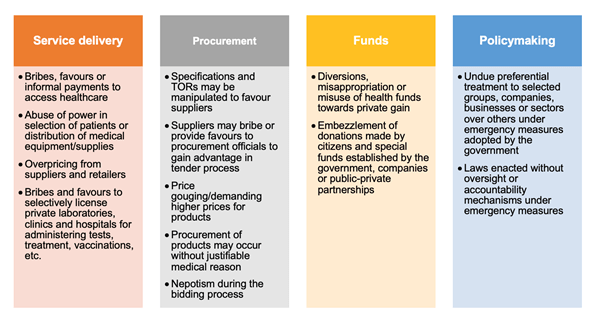
Crisis such as the COVID-19 pandemic further exacerbate the risk of corruption, particularly when country systems are fragile and there are limited or no effective oversight, audit and accountability mechanisms. In particular, conditions such as flexibility in responses, the simplification of procurement controls, the rapid flow of large funds, and the need for urgent responses instigated by the crisis create increased opportunities for corruption and fraud in the health sector.
Understanding the concepts
Corruption: The United Nations refrains from using a conclusive definition because of the complexity of the phenomenon and the different nuances that it takes in different contexts. Nevertheless, there is the most commonly accepted definition that is proposed by Transparency International as “the abuse of entrusted authority for private gain.”
Accountability: Accountability can be understood as those mechanisms that make institutions responsive to their particular publics. It requires institutions or organizations to be accountable to those who will be impacted by their decisions. Accountability can reduce corruption and other abuses, assure compliance with standards and procedures, and improve performance and organizational learning
Transparency: Accountability and transparency are essentially coupled. Accountability requires transparency and vice versa. Transparency can be understood as when citizens are informed about how and why public policy decisions are taken. It means shedding light on formal and informal rules, plans, processes and actions so that the public can hold power to account.
Sources: Kohler & Bowra.(2020); Transparency International: What is Corruption
UNDP’s approach
Through its Global Anti-Corruption Initiative (GAIN) and regional anti-corruption programmes, UNDP provides policy and programme support on anti-corruption, transparency, and accountability across sectors in more than 80 countries annually, working with a broad range of partners. Building on its governance expertise and health systems strengthening portfolio, UNDP is well positioned to advance integrated work in health, development and good governance.
For more than a decade, UNDP has harnessed these experiences to develop and support countries to apply methods and good practices to map corruption risks, develop strategies to address them, and sustain partnerships to tackle corruption in the health sector.
This work is done in partnership with a broad range of stakeholders at the global, national and regional levels, including international financing institutes, civil society organizations, the United Nations Office on Drugs and Crime UNODC, the Global Fund to Fight AIDS, Tuberculosis and Malaria (Global Fund), the World Health Organization (WHO) and the World Bank.
UNDP’s particular emphasis as a partner includes supporting the implementation of risk-based frameworks for corruption prevention, strengthening fiduciary control and internal audit systems in national institutions, and promoting social accountability, including through the use of digital technology.
UNDP’s entry points and Examples
Supporting the implementation of risk-based frameworks for corruption prevention
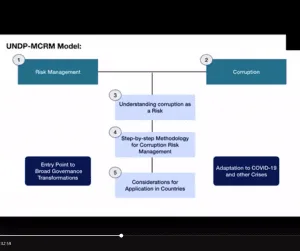
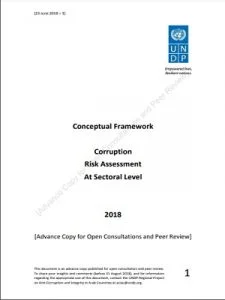
Building on lessons that emerged through the UNDP Anti-Corruption and Integrity in the Arab Countries (ACIAC) programme and regional expert group consultations in 2015-2016, UNDP developed the Conceptual Framework for Corruption Risk Assessment at Sectoral Level. Through the framework, UNDP has supported several countries to customize and apply a targeted approach to corruption prevention based on an understanding of risk, equipping partners with the conceptual underpinnings to focus on corruption as a starting point for more comprehensive governance reforms.
Case Study: Capacity building workshop on Corruption Risk Management in the Health Sector
In Guinea-Bissau, UNDP, with support from the Government of Japan and in partnership with Health Governance International (HGI), has worked to strengthen the health sector’s ability to identify, manage and prevent corruption. Through a three-day capacity-building workshop, government officials were introduced to a step-by-step, risk-based approach to corruption prevention, engaging in practical exercises to apply these methodologies to their local context. The training focused on evaluating and mitigating vulnerabilities at various levels of health service delivery. By empowering stakeholders—from senior officials at regional hospitals to frontline health workers—this initiative fosters a network of allies committed to promoting transparency and accountability. This training not only expanded technical skills in corruption risk management, but also supported the formation of a community dedicated to ensuring more effective and equitable health outcomes for people in Guinea-Bissau.
Case Study: Piloting the corruption risk assessment in Tunisia
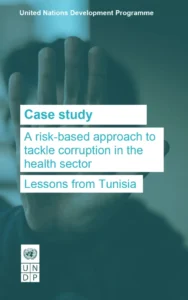
In Tunisia, the first country where UNDP introduced its approach to sectoral corruption risk assessment, the framework supported the health sector to identify and mitigate the risk of corruption at multiple levels of health service delivery, improving transparency and efficiency of services in several public hospitals. A key aspect of the implementation was its multi-stakeholder participation, bringing together health personnel and members of the anti-corruption body to collaborate on risk mapping and the development of comprehensive strategies aimed at enhancing transparency and accountability. The initiative delivered quantitative and qualitative results, including increased patient access to services, higher patient satisfaction, reduced expenditures and shortened wait times for surgeries, making a positive impact on both healthcare delivery and the broader health system.
For more information and guidance on UNDP’s corruption risk management methodology, visit the following page.
Strengthening fiduciary controls and internal audit systems in national institutions
As part of its work to strengthen systems for health, UNDP’s technical assistance to ministries of health entails capacity development of systems and processes for financial management, oversight, audit, and accountability. Building institutional capacities in these areas plays a key role in reducing opportunities for corruption risks to emerge within health programmes and service delivery. It moreover enables the maximization of health benefits from public resources and builds public trust in the system. More broadly, UNDP proactively supports national institutions to integrate anti-corruption, transparency and accountability measures into national development plans and processes, including strategies specific to the health sector.
Case Study: Promoting anti-corruption, transparency and accountability through internal audit in Zimbabwe
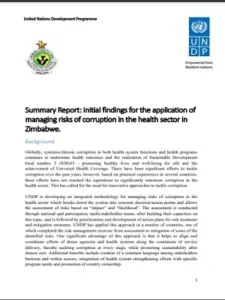
In Zimbabwe, over the past decade, UNDP, in partnership with the Global Fund to Fight AIDS, Tuberculosis and Malaria (Global Fund), has supported the Ministry of Health and Child Care to strengthen its internal audit function through the adoption of a risk-based approach. Key milestones included the development of a revised internal audit charter, an internal audit operating policy and a memorandum of understanding between internal audit and management. A risk management policy, strategy and audit programme was also launched, which provided a framework for the sector-wide approach to risk. UNDP also supported the Ministry of Health and Child Care to improve the utility of the public financial management system for managing donor funding and to ensure linkages with the internal audit function.
Promoting social accountability, including through the use of digital technology
UNDP works to strengthen social accountability in service delivery, oversight in health policymaking, and the monitoring and evaluation of services. This includes through the use of innovation and technology platforms that enable citizen monitoring and strengthen access to public information, to help expose and reduce corruption. More broadly, UNDP works to empower civil society organizations to independently engage with government, including through participation in multi-stakeholder anti-corruption and health fora and the design of national strategies for good governance in health.
Case Study: Leveraging digital technology to fight corruption in health procurement in Ukraine
Likewise, UNDP supports the use of technology to enhance the availability and transparency of data for decision making, including through public procurement systems and logistics management information systems for health. In Ukraine, for instance, UNDP supported the development of the national e-procurement platform Prozorro, which was launched to allow government bodies to conduct procurement deals electronically and transparently and give citizens open access to the contracts. DoZorro is a tool to identify corruption risks, as part of which citizens can submit feedback and report violations across the procurement cycle.
Resources and partnership platforms
Guidance based on experiences at the global, national and regional levels
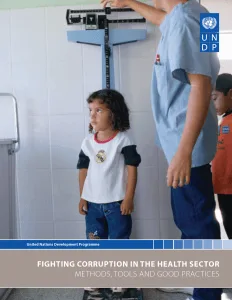
With its operational presence in countries and diverse experiences supporting countries to plan and implement anti-corruption, transparency and accountability measures, UNDP contributes to the global evidence base on effective strategies to fight corruption. It likewise plays a convening role to facilitate the exchange of good practices and lessons learned across countries and among different sectors. Over the years, UNDP has produced a wide range of knowledge products on corruption, including methods specific to the health sector. Examples are the study ‘Fighting Corruption in the Health Sector, Tools, Methods and Good Practices (2015)’. The first draft of the ‘Conceptual Framework for Corruption Risk Assessment at the Sectoral Level’ (2018), which was published by UNDP’s Regional Bureau for Arab States which has further guidance under development and the guidance note on ‘Integrating Transparency Accountability, and Anticorruption in Socioeconomic Impact Analysis, Needs Assessment and Response to the COVID-19 Pandemic’ (2020), published by the UNDP Global Anti-corruption team.
Promoting risk management within health programmes
Proactive risk management is a cornerstone of UNDP’s programme management approach in supporting countries to implement large-scale national health programmes, including through its role as interim Principal Recipient of Global Fund grants from the Global Fund to Fight AIDS, Tuberculosis and Malaria (Global Fund) in countries facing significant capacity constraints. UNDP has developed robust systems and tools to help countries identify and manage potential risks, and ensure ethics and integrity are in place in processes for programme management. Further guidance and tools on UNDP’s approach to risk management in the context of Global Fund grants can be found in the UNDP-Global Fund and Health Implementation Guidance Manual.
Global partnership to fight corruption in health
In 2019, UNDP, the Global Fund to Fight AIDS, Tuberculosis and Malaria (Global Fund) and the World Health Organization (WHO) – and subsequently the World Bank as well – formed the steering committee of the Coalition for Accountability, Transparency and Anti-Corruption in Health (CATCH), a dynamic network that brings together a multiplicity of partners (e.g. health, development and humanitarian agencies; governments; civil society and, private sector organizations; people from academia and citizens) to tackle corruption in the health sector. CATCH aims to build the evidence base on how to tackle corruption, enhance collaboration and coordination among stakeholders, foster partnerships across and between countries and support countries to mobilize resources for anti-corruption efforts, hence reducing countries’ vulnerability to corruption. UNDP plays a lead role in the workstream to implement corruption risk assessments at the country level, to help generate bespoke corruption prevention solutions.
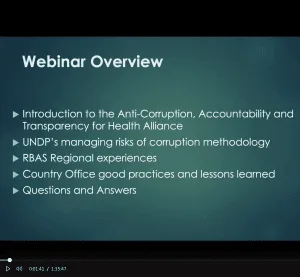
Some joint knowledge products to date CATCH has collaborated on a number of activities. In September 2019, CATCH hosted a high-level side-event at the UN General Assembly, where the need for safe spaces to host open and honest conversations on the difficult realities that surround corruption was discussed. The WHO Special Bulletin on ACTA highlights outcomes from research. CATCH published a joint blog on COVID-19 and ACTA, hosted two webinars in Nov-Dec 2020 to train UNDP Country Offices on the corruption risk management methodology (see the “Corruption risk methodology” page for recordings), and continues to prioritize fundraising efforts to advance its workstreams
Some joint knowledge products of CATCH to date include a WHO special bulletin on anti-corruption, transparency and accountability (ACTA) for health, a joint blog on COVID-19 and anti-corruption, transparency and accountability, and two webinars hosted by UNDP on its corruption risk management methodology (see the “” page for recordings).
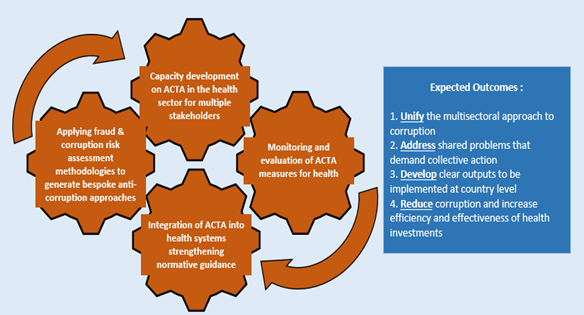
The coalition helps to unify multisectoral approaches to corruption and identify shared problems that demand collective action and can drive outputs that are implemented at the country level, supported by the research and policy communities. Among the priority areas that have emerged from multi-stakeholder consultations is the need for risk-based approaches to anti-corruption for health. UNDP plays a lead role within this workstream, helping to inform implementation approaches and provide technical assistance to support countries to leverage risk assessments tailored to health systems.
To date, CATCH has collaborated on a number of activities. In September 2019, CATCH hosted a high-level side-event at the UN General Assembly, where the need for safe spaces to host open and honest conversations on the difficult realities that surround corruption was discussed. The WHO Special Bulletin on ACTA highlights outcomes from research. CATCH published a joint blog on COVID-19 and ACTA, hosted two webinars in Nov-Dec 2020 to train UNDP Country Offices on the corruption risk management methodology, and continues to prioritize fundraising efforts to advance its workstreams.
Voices from the coalition
What kind of approaches are most effective in reducing corruption at the country level?
Are our current ACTA approaches fit for purpose?
How can increased transparency and accountability pave the way for UHC?