UNDP Logo
Global
Capacity Development
for Health

Community systems strengthening

Capacity Development for Health | Generated on December 15, 2025

Table of Contents

Community systems strengthening for improved health outcomes

Overview

What do we mean by community systems strengthening?

Community systems strengthening is an approach that promotes the development of informed, capable and coordinated communities and community-based organizations, groups and structures. It involves a broad range of community stakeholders and enables them to contribute to the long-term sustainability of health and other interventions at the community level, including by creating an enabling and responsive environment in which these contributions can be effective. Learn more

Community systems strengthening has a strong focus on capacity-building and on strengthening human and financial resources, with the aim of enabling communities and community actors to play a full and effective role alongside government health and social welfare systems. Community groups and networks often face a range of barriers that limit their effectiveness and their ability to take a systems approach. This includes a lack of resources, capacity and support, and challenging legal, social and policy environments.

The goal of community systems strengthening is to achieve improved health outcomes by strengthening the capacity of individuals and civil society to advocate for, participate in and influence health governance and delivery at global, national and regional levels. This includes sharing tools, innovative approaches, insights and good practice across a broad range of organizations and networks.

The contribution made by communities to health has not always been recognized or supported and there is now renewed interest in strengthening capacity and linkages to develop community health systems as a valuable resource in their own right. This is particularly the case in the response to AIDS, tuberculosis and malaria, for which community models have been shown to improve outcomes related to access, coverage, adherence, viral suppression, retention in care and survival.

The Global Fund to Fight AIDS, Tuberculosis and Malaria (Global Fund) Strategy 2023-2028 acknowledges community responses and systems as crucial, diverse, dynamic and highly adaptable. The Global Fund has pioneered work in community systems by strengthening and investing in strategies that maximize the participation of key populations, community organizations and networks in the design, delivery, monitoring and evaluation of services and activities aimed at improving health. The Global Fund’s approach to nature of interactions that exist between disease control programmes, primary health care and communities.

Community systems strengthening and COVID-19

The COVID-19 pandemic has highlighted both the fragility and the resilience of community systems, underscoring the importance of community systems strengthening in the context of health responses. An analysis of COVID-19 Task Force compositions in 24 countries published in The BMJ in 2020 showed that women are in the minority on these Task Forces, that civil society is not generally included, and that communities are not consulted before decisions are made that affect the whole of society. Decisions about which interventions to implement, how they are implemented and who makes these decisions have an impact on the country’s priorities and eventually determine how many lives are lost as a result of secondary impacts caused by the response to COVID-19. It is likely we will see more deaths from diseases such as HIV and tuberculosis in countries where civil society capacity to advocate for access to services remains low or impaired.

UNDP’s approach

UNDP’s expertise in institutional development and, in planning, financial management, monitoring and evaluation and its wide-ranging technical expertise in health and human rights, make it the ideal partner for community systems strengthening. In addition, and importantly, UNDP is well positioned to facilitate civil society’s participation in policymaking and decision-making at regional, national and sub-national levels.

UNDP is often called upon to support development coordination mechanisms at the country level, assist countries to formulate their national development strategies and align them with the Sustainable Development Goals. This is facilitated by long-standing UNDP partnerships at the highest levels of government, with law-making bodies such as parliaments and with civil society organizations.

UNDP, with its breadth of expertise and country presence, is unique within the United Nations Development System to help countries to connect the dots on the most complex sustainable development issues. The organization also has very strong organizational capacity, demonstrated over many years, and mechanisms in place to rapidly amplify messages across countries and regions. Given this and its reputation as an impartial partner, UNDP helps governments to convene across line ministries and development partners to promote whole-of-government and whole-of-society responses vital for transformational change. This includes ensuring that civil society is able to participate in a meaningful way in policy-making and decision-making mechanisms and forums.

UNDP has extensive experience in community systems strengthening for health, building on its early focus on enhancing community conversations for HIV. UNDP draws on strong technical expertise at global and regional levels and has the capacity to convene a wide range of stakeholders, including from the United Nations family. UNDP’s strategic plan (2022–2025) speaks to how development challenges are increasingly complex, requiring ever greater collaboration across sectors and partners to deliver impacts at scale and to utilize limited resources efficiently. This makes UNDP uniquely positioned to facilitate community engagement and representation with government.

UNDP’s entry points
  1. Ensuring that programming is based on gender and human rights, including the right to health and to freedom from discrimination.
  2. Facilitating commitments to increase accessibility, uptake and effective use of services to improve the health and well-being of communities
  3. Ensuring that programming is informed by evidence and responsive to community experience and knowledge
  4. Facilitating a significant and equitable role in all aspects of programme planning, design, implementation and monitoring for community-based and community-led organizations, key populations and communities.
  5. Ensuring accountability to communities, for example, accountability of networks to their members, of governments to their citizens, and of donors to the communities they aim to serve.

The following page provides further details on key programme areas and opportunities to strengthen community systems.

Tools and guidance

The following UNDP information notes offer additional background and considerations to inform community systems strengthening:

  • Defining key concepts. This offers guidance on: What do we mean by community? What is the difference between a community-led and a community-based organization? What is civic space? What do we mean by community systems for health?
  • The role of community systems. This describes the unique added value of communities in national health responses and how community systems fit within the priorities of global health frameworks.
  • Considerations for strengthening community systems. This details key enabling factors to consider when planning work with communities to strengthen systems.

Much of UNDP’s work to strengthen community systems builds on its partnership with the Global Fund, including through its role as interim Principal Recipient of grants from the Global Fund to Fights HIV, Tuberculosis and Malaria (Global Fund). The Global Fund has developed a set of four measurement frameworks that cover HIV/AIDS, tuberculosis, malaria and health system strengthening. Each of the measurement frameworks include a community systems strengthening module and each of these contains four interventions aimed at strengthening community systems. The community systems strengthening interventions provide the opportunity and funding to enable communities and community-based organizations to maximize their contributions to the AIDS, tuberculosis and malaria responses and address any gaps that may impede this.

Additional tools and guidance from partners can be found in the key resources below.

Examples

Case study: How a community-based strategy helped reduce malaria in Afghanistan

Started in 2013, Afghanistan’s community-based malaria management strategy was scaled-up in 2016 by UNDP and the Global Fund, expanding rapid diagnostic testing to all health facilities nationwide. The initiative introduced malaria screening to community health posts, provided anti-malarial medicines and health products to all health posts and facilities, and trained 30,000 community health workers on rapid testing and case management. The expansion helped reduce malaria incidence from 15.4 to 5.5 cases per 1,000 people annually, reaching zero malaria deaths, from 2012-2019.

Read more here.

Case study: Boma Health Initiative: Integrated community health services in South Sudan

Launched in 2017 by South Sudan’s Ministry of Health, the Boma Health Initiative is training and equipping 2,500 community health workers and 135 supervisors to deliver an integrated package of health services in remote areas, bridging the gap between communities and health facilities. Supported by UNDP and the Global Fund, the community health workers conduct HIV and TB contact tracing and treatment enrolment and monitoring, treat common childhood illnesses such as malaria, diarrhoea and pneumonia, screen for malnutrition and provide health education to encourage immunization, disease prevention and access to antenatal and postnatal care. Through the District Health Information System (DHIS2), these activities strengthen the community health components of South Sudan’s national health system, improving access to quality care across the country.

Read more here.
Key Resources

The People Living with HIV Stigma Index 2.0

UNDP Pakistan
AUTHOR: UNDP LANGUAGE: English FILE FORMAT: Web Link

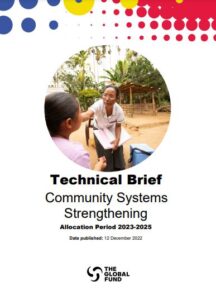
Technical Brief: Community Systems Strengthening

The Global Fund
AUTHOR: The Global Fund LANGUAGE: English FILE FORMAT: PDF

Community Systems Strengthening Framework

The Global Fund
AUTHOR: The Global Fund LANGUAGE: English FILE FORMAT: Web Link

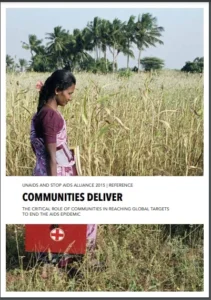
The Critical Role of Communities in Reaching Global Targets to End the AIDS Epidemic

UNAIDS, Joint United Nations Programme on HIV/AIDS, Stop AIDS Alliance.
AUTHOR: UNAIDS LANGUAGE: English FILE FORMAT: PDF

Accelerator 3: Community and Civil Society Engagement Discussion Paper

Global Action Plan for Healthy Lives and Well-being for All
AUTHOR: WHO LANGUAGE: English FILE FORMAT: PDF

Interventions for community systems strengthening

Purpose

Community system strengthening is about strengthening systems. It is about investing in the system pillars that enable community organizations and key population networks and groups to maximize their contribution to all aspects of health programming. Strengthening community systems also means investing in an environment that is enabling for communities and community organizations and ensuring that there is a place at the table for civil society organizations to be consulted on health-related decisions at every step.

Intervention areas

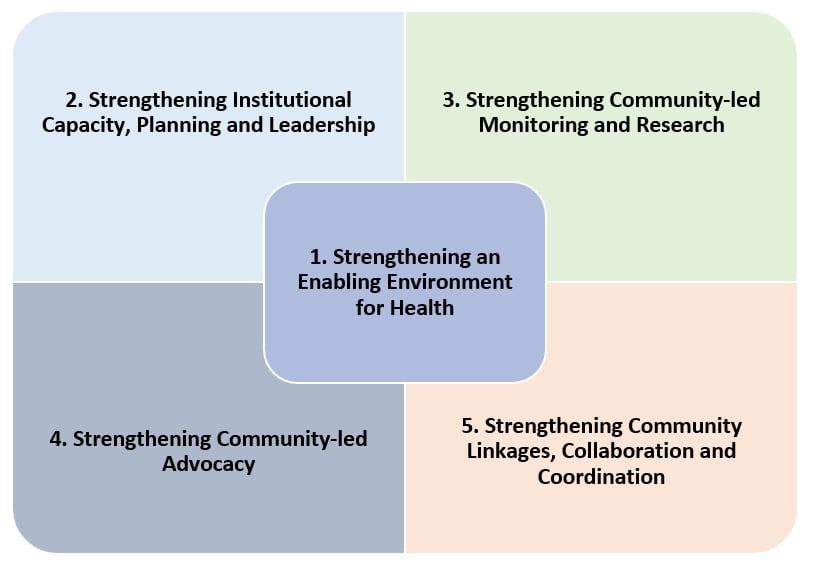
There are five main interventions that UNDP deploys for community systems strengthening: 1) strengthening an enabling environment for health; 2) strengthening institutional capacity, planning and leadership; 3) strengthening community-led monitoring and research; 4) strengthening community-led advocacy; and 5) strengthening community linkages, collaboration and coordination.

Building an enabling environment for community systems

This intervention involves work with other stakeholders to create and reinforce a legal, policy, regulatory and strategy environment that is conducive and responsive to health for all sectors of the community and that reinforces the work of community-led organizations. It is important to involve community-led and key population organizations in the design, implementation and monitoring of activities in this intervention.

It includes:

  • Providing financial and/or technical support for capacity strengthening of key duty bearers such as parliamentarians, national human rights institutions, health service providers, policymakers, law enforcement officials, lawyers and the judiciary to create an awareness of the importance of community systems and of the barriers to health and access to services that particular communities or groups face. Duty bearers need to be able to understand and address legal, policy, regulatory and strategy barriers to access to health services and have the capacity to avert and respond to human rights violations.
  • Providing financial and/or technical support for capacity strengthening of key duty bearers to understand the important role played by policy dialogue and community-led advocacy in access to health, to ensure the provision of necessary space for community-led advocacy and to protect the safety of activists.
  • Providing technical support and advocate for the inclusion of community systems and activities in health and other relevant strategies, budgets, indicators and targets at national and sub-national levels.
  • Providing technical support and advocating for the registration of community groups by the government.
  • Advocating with donors and the government for stable and predictable financial resources and core funding for community systems, as lack of core funding is often a barrier to effective institutional development for community-led organizations.
  • Advocating for or providing technical support to strengthen the capacity of health systems to generate accurate data that can be used by community systems to track quality and coverage of health services, health policy, targets and financing. Lack of good data are a common barrier to community-led monitoring of health services.

Strengthening institutional capacity, planning and leadership

This intervention involves strengthening the capacity of individuals, community groups, organizations and networks in a range of areas necessary for them to fulfil their roles in service provision, social mobilization, monitoring and advocacy.

It includes:

  • Providing financial and/or technical support and mentoring for planning, financial management, institutional and organizational development, systems development, human resources and leadership development, transparency, equity and community sector organizing.
  • Providing financial and/or technical support (including training and tools) to the community sector as required to enable them to fulfil roles in service provision, social mobilization, monitoring and advocacy. Community members should not be asked to work without proper remuneration.  It is necessary to find or provide support for both core funding for community-based organizations and networks, including organizational overheads and staff salaries and stipends, and targeted funding for implementing programmes and interventions.
  • Providing financial and/or technical support (including training, tools and equipment) for strengthening e-governance of community systems and to build social media capital and capacity to ensure data security and confidentiality. This involves support to develop and roll out digital community platforms and other mechanisms that enable flexible communication in situations where in-person contact is unsafe, unfeasible or undesirable (for example in contexts where surveillance and criminalization make face-to-face advocacy challenging). These platforms should facilitate key population and other community groups to share information, communicate with their constituents, contribute to national and subnational planning, and participate in other consultations and decision-making processes.

Strengthening community-led monitoring and research

This intervention involves strengthening the capacity of community-based organizations and other community groups to monitor, document and analyse the performance of health services as a basis for accountability, advocacy and policy activities. Key population groups often have their own long-established ways of collecting and acting on information. Community-based monitoring simply formalises and builds on these systems, linking them to services provided by the government and non-governmental organizations. Refer to the Health Information Systems section for more information.

It includes:

  • Providing financial and/or technical support (including training and tools) to establish and implement community-led mechanisms for ongoing monitoring of health policies and strategies, of performance against targets and of the quality of health services and related activities.
  • Providing financial and/or technical support for community-led monitoring and tracking of other factors that are part of an enabling environment for health and well-being, such as financing of programmes, discrimination, gender-based inequalities and other social, economic and environmental determinants of health. Again, this is dependent on having good national and subnational information.
  • Providing financial and/or technical support (including training and tools) for operational research and the generation of research-based and experiential evidence for results-based programming. Good practice dictates that research is community-led, meaning that community members take a lead in the design of research protocols and methods, the collection and analysis of data and the dissemination and validation of findings. How to effectively maintain confidentiality is usually an important issue to consider in community-led research. Experts involved should be there to facilitate communities to decide what is important to research, how research is carried out and what happens to research findings.

Strengthening community-led advocacy

This intervention involves strengthening the capacity of community-led organizations and key population groups to hold service providers, national programmes, policy-makers, and local and national leaders accountable for the effective delivery of services and other health-related activities.

It includes:

  • Providing financial and/or technical support (including training and tools) and mentoring for community-led organizations and key population groups to design and conduct advocacy activities at local and national levels aimed at holding to account those responsible for health policy and service provision, including disease-specific programmes. Advocacy activities aimed at broader issues that affect health and access to services are also important, such as activities that highlight discrimination, gender inequality, sustainable financing and the protection and promotion of human rights.
  • Providing financial and/or technical support to develop and adapt policy engagement scans and other tools that can be used to highlight the process by which civil society organizations can engage with policy and law reform, in a particular country or region, to influence health responses.
  • Providing financial and/or technical support (including training and tools) to enable community-led organizations and key population groups to effectively use data and findings from monitoring and research activities for advocacy with key duty bearers, such as parliamentarians, national human rights institutions, service providers, policymakers, law enforcement officials, lawyers and the judiciary. This would include developing materials in support of strategic litigation, developing and disseminating policy and media briefs, and developing material for social media, webinars and other online events. It would also include support to conduct training and to develop training materials.

Strengthening community linkages, collaboration and coordination

This intervention involves strengthening the capacity of community organizations and networks to work within a community systems framework.

It includes:

  • Providing financial and/or technical support and mentoring to develop platforms and mechanisms for networking and for developing effective linkages within and between community groups and networks working on different aspects of improving health and well-being. Mechanisms for coordinating and collaborating with broader movements should also be developed, to mainstream health issues in, for example, human rights, environmental and women’s movements.
  • Providing financial and/or technical support and mentoring to develop strong informal and formal relationships between communities, community stakeholders and other stakeholders to enable them to work in complementary and mutually reinforcing ways, maximizing the use of resources and avoiding unnecessary duplication and competition. This might involve the use of memoranda of understanding to cement partnerships between community organizations, developing consortia for joint access to funding, onward referral of clients, sharing training opportunities and materials, sharing technical expertise, seconding staff between community organizations and mentoring new community organizations or key population groups. It might also involve creating space for community dialogues so that key issues can be discussed and priorities agreed on.

Key Resources

Guidance Note on Community Systems Strengthening and Tuberculosis

Stop TB Partnership
AUTHOR: Stop TB Partnership LANGUAGE: English FILE FORMAT: Web Link

Capacity Development for Health
https://beta-cd4health.org
Generated on December 15, 2025 at 8:05 PM