Global
Capacity Development
for Health
for Health
As outlined in the UNDP Strategic Plan 2022-2025, UNDP’s support to countries aims to eradicate poverty in all its forms and dimensions, accelerating structural transformation for sustainable development and supporting governments to build resilience to shocks and crises. UNDP partners with governments, including ministries of planning, development and finance, and with law-making bodies, civil society organizations, the private sector, citizens and other key stakeholders to achieve the Sustainable Development Goals (SDGs) and fulfil the pledge to leave no one behind.
Health plays a central role in achieving the Sustainable Development Goals and is both a precondition and an outcome of sustainable development.”
– Achim Steiner, UNDP Administrator
UNDP’s commitment to addressing HIV and other major health and development challenges is based on the principles that health is a driver for and an indicator and outcome of development, and that actions across a wide range of development sectors have a significant impact on health outcomes. As a development agency, UNDP focuses on addressing the social, economic, legal, commercial and environmental determinants of health. It embraces a human rights-based approach and looks through a gender equity lens to address the underlying drivers of health inequities. UNDP’s efforts to strengthen systems for health are guided by its emphasis on supporting countries to attain universal health coverage, an important target under SDG 3 (healthy lives and well-being for all) to advance health outcomes and equity.
UNDP’s work on HIV and health is carried out in close collaboration with a broad range of partners across development sectors, including governments, civil society organizations, United Nations entities and other intergovernmental organizations, multilateral and bilateral donors, development banks, academia, the private sector and other development partners.
The UNDP HIV, Health & Development Strategy 2022-2025 Connecting the dots: Towards a more equitable, healthier and sustainable future outlines UNDP’s unique contribution to health through its interconnected efforts to 1) reduce the inequalities and social exclusion that affect health and drive epidemics; 2) promote effective and inclusive governance for health; and 3) build resilient and sustainable systems for health. This work is undertaken by an integrated team operating at global, national, regional and local levels.
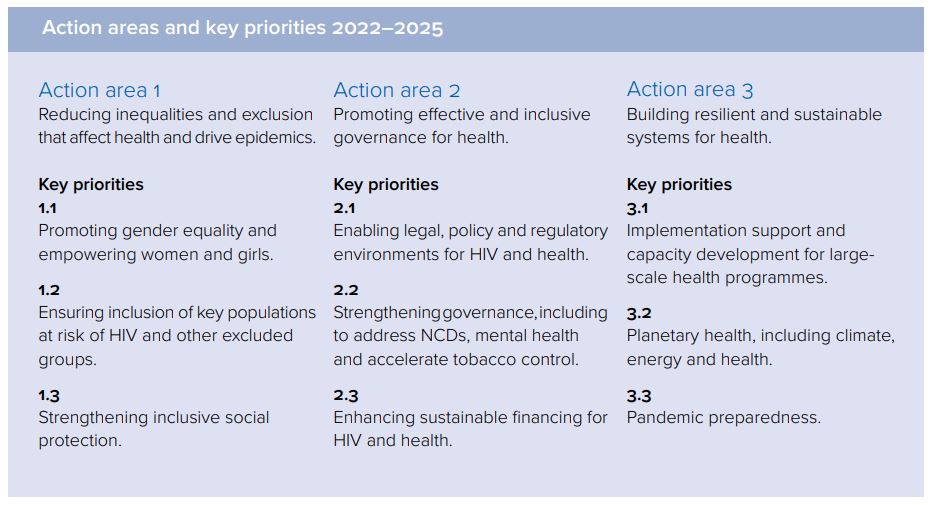
A key channel for UNDP’s efforts to build resilient and sustainable systems for health is its support to national governments to implement large-scale health programmes in challenging, complex and high-risk country contexts (Action area 3.1). UNDP currently supports programme and policy interventions to strengthen systems for health in over 60 countries. This includes the implementation of HIV, tuberculosis (TB) and malaria grants funded by the Global Fund to Fight AIDS, Tuberculosis and Malaria (The Global Fund) in 22 countries and two regional programmes that cover an additional 11 countries in 2021. In other countries, based on demand, UNDP provides direct support to national partners for the implementation of health programmes and the strengthening of systems, such as capacity-building to strengthen national institutions or support health procurement.
Resilient systems for health are needed more than ever where conflicts and crises persist and where natural disasters are most prone to strike. A targeted approach ensures that the most vulnerable are reached. UNDP continues to work with governments and civil society organizations to help focus on the areas of most need or where epidemics present a public health concern. More investments in strengthening health and community systems will ensure that those most in need receive vital assistance.
The breadth of UNDP’s expertise and country presence puts it in a unique position within the United Nations Development System and global health landscape to help countries “connect the dots” on some of the most complex health and development issues. It is well placed to support countries in tackling the interconnected underlying determinants affecting health and well-being.
All UNDP support for the implementation of HIV, TB, malaria and health programmes is complemented by the capacity development of national institutions and implementing partners, coupled with engagement at the policy level to create enabling environments. These efforts contribute to and draw on UNDP’s health and development expertise. For example, as part of promoting effective governance, technical support to promote anti-corruption, transparency and accountability within the health sector, in partnership with the Global Fund, the World Health Organization (WHO) and others, forms part of UNDP’s support to strengthen the capacity of systems for health.
All UNDP support for the implementation of HIV, TB, malaria and health programmes is also underpinned by efforts to ensure sustainability, including a focus on environmental sustainability. UNDP’s work on planetary health brings together efforts on climate action, with health programming to offer win-win solutions for the health of people and the planet. For example, UNDP supports innovative initiatives to embed sustainability into health procurement supply chains and promotes the use of clean energy to reduce the carbon footprint of health facilities
UNDP defines capacity development as the process through which individuals, organizations and societies obtain, strengthen and maintain the capabilities to set and achieve their own development objectives over time. Capacity development is fundamentally about unlocking transformative change, that is, change that is generated, guided and sustained by those whom it is meant to benefit. In the context of UNDP’s programme and policy support for health and development, capacity development represents a fundamental component that cuts across all areas of its work at the global, national and regional levels. This includes a particular emphasis on capacity development to improve the performance of national health systems, ensuring quality, equity, efficiency, accountability, resilience and sustainability.
UNDP operates strictly in support, and within the framework, of national health plans and disease-specific national strategies, under the leadership of national health authorities and acknowledging the crucial role of civil society, the private sector and technical partners. Promoting national ownership, developing capacity and strengthening national systems is central to UNDP’s engagement. It therefore operates through existing country systems to promote national ownership, including national health information systems, procurement and supply chain systems, and public financial management systems. It helps national entities to design and implement capacity development plans, address priority gaps and build greater resilience and sustainability.
As part of promoting sustainability, UNDP does not implement health programmes itself, but rather supports implementation by national governments, non-governmental organizations (NGOs) and private sector entities. For example, in its role as interim Principal Recipient of the Global Fund grants, a primary focus is to build national capacities to enable the gradual and sustainable transfer of the Principal Recipient role to national entities while strengthening broader systems for health. Greater national ownership is also promoted by ensuring that programme performance indicators align with the objectives of national strategies.
With its global reach, broad mandate and integrator role, UNDP is uniquely positioned to support the kind of systemic and structural change needed at the scale required to bring about sustainable, institutional transformation of systems for health. UNDP’s broad country presence and diverse experience in supporting national entities to implement large-scale public health programmes have allowed it to develop expertise and frameworks to support functional capacities identified as critical for efficient and effective systems for health. These include having trained and motivated health workers, a well-maintained infrastructure and a reliable supply of health commodities, backed by adequate funding, strong strategic plans and evidence-based policies.
This website details UNDP’s approach, processes, and tools for capacity development 1) within the context of health programme implementation and management, and 2) in support of building resilient and sustainable systems for health at national and sub-national levels. All UNDP support is complemented by capacity development. In some countries, UNDP’s support focuses only on strengthening systems for health, through the provision of technical assistance to ministries of health. For example, through government financing agreements with ministries of health in numerous countries, UNDP supports the procurement of health products while providing end-to-end capacity-building to enhance national supply chains.
Among the key vehicles through which UNDP is able to provide end-to-end capacity development support to countries is its partnership with the Global Fund. When UNDP is called on to manage the Global Fund-funded HIV, TB, malaria and health systems-strengthening grants as interim Principal Recipient in countries facing special implementation challenges, a priority of this engagement is to develop the capacities of governments and/or civil society organizations to take over the grants when circumstances permit. The partnership’s contributions to making systems for health more resilient and helping countries to strengthen laws and policies not only supports the HIV, TB and malaria response, but also increases the capacity of health systems more broadly to work towards universal health coverage and other health-related SDGs. See the UNDP-Global Fund Partnership page for more information.
UNDP’s support includes the development of frameworks for effective programme management, monitoring and oversight; the training of implementing partners, including civil society and national coordinating bodies; assistance with assessing capacity gaps and developing capacity development and programme transition plans; and the domestic financing of health programmes. Core focus areas for UNDP’s support to strengthen the resilience and sustainability of systems for health include support for the development of national strategies, health management information systems, procurement and supply chain management systems, public financial management and internal audit systems, and human resources for health and community systems, and support for environmental sustainability, harnessing innovation and digital solutions for health.
This multidimensional support for systems for health is all the more crucial in the context of emerging global health threats, humanitarian crises, fragility and other challenging operating environments. UNDP’s support is focused on countries that are characterized by weak governance and poor access to health services, and that require dedicated programmes to develop capacity. UNDP takes a risk-informed approach to help national entities improve performance and quality, reduce inefficiencies and raise transparency and accountability for better health outcomes. This includes leveraging its existing risk management tools and frameworks. The nature of UNDP’s core development mandate also enables it to connect sectors, stakeholders and levels of action, helping countries translate goals into concrete programmes and measurable impacts on the ground. Its work to bridge the nexus between humanitarian action and development likewise helps to eliminate silos and strengthens countries’ resilience to shocks. In this way, UNDP’s capacity development support for systems for health benefits from an existing network of multi-stakeholder partnerships, cross-sector policy engagement and implementation expertise, and the ability to tap into lessons learned at global level and resources while providing highly contextualized and evidence-based action on the ground.
The following principles guide UNDP’s approach to capacity development for resilient and sustainable systems for health:
Through these principles, UNDP has built a comprehensive multidimensional approach to capacity development for health based on a methodology developed and tested on the ground. The approach ensures that capacity gaps are identified and analysed and fed into prioritized capacity development plans and interventions, which are implemented and monitored against performance indicators.
Strong partnerships are the cornerstone of UNDP’s work to strengthen systems for health. In its support to countries UNDP works closely with other United Nations entities, development organizations, civil society organizations, the private sector, academia and key populations to develop resilient and sustainable systems for health. This page highlights some of UNDP’s key partners for health and outlines how collaboration, drawing on the comparative advantages, can facilitate greater impact and sustainability. At the regional and global levels, UNDP helps to drive the health agenda through its participation and thought leadership in a number of multi-stakeholder initiatives. This includes collaboration with 12 multilateral agencies under the SDG 3 Global Action Plan for Healthy Lives and Well-being for All.
UNDP has worked in partnership with the Global Fund since its inception in 2002 to implement grants to tackle the epidemics of HIV, tuberculosis (TB) and malaria in some of the most challenging operating environments. UNDP has served as interim Principal Recipient of the Global Fund grants in 53 countries since 2002, supporting governments to implement large-scale health programmes, strengthen systems for health and reach marginalized and hard-to-reach populations with critical services, often in some of the most challenging country contexts.
UNDP’s partnership with the Global Fund focuses on three interlinked objectives: 1) supporting implementation, 2) developing the capacity of national entities to assume the Principal Recipient (PR) role as soon as circumstances permit, and 3) strengthening the policy and programme quality of the Global Fund-related work. Through this approach, UNDP has successfully transitioned the PR role to national entities in over 30 countries since 2002, including for several regional grants. Cumulatively, the partnership has contributed to saving 7.3 million lives and has also helped 56 million people to receive counselling and testing for HIV, 967,000 TB cases to be treated, 88.5 million cases of malaria to be treated and 77.4 million bednets to be distributed. 1.4 million people currently receive HIV treatment through UNDP’s partnership with the Global Fund. Learn more here.
On 4 May 2018, the World Health Organization (WHO) and UNDP signed a memorandum of understanding to help support countries to achieve the health-related targets of the 2030 Agenda, with an emphasis on the realization of their commitment to leave no one behind. In current WHO–UNDP collaborations, there is a joint commitment to strengthening country capacity to achieve universal health coverage, supporting multisectoral responses to health emergencies and ensuring the delivery of essential health services in fragile, vulnerable and conflict-affected settings.
In line with WHO’s leadership on universal health coverage, UNDP and WHO are supporting countries to strengthen the capacity of their health systems, including by addressing the social, economic and environmental determinants of health. UNDP and WHO have developed a joint programme on activating national responses to non-communicable diseases to support countries to develop national responses to their non-communicable disease epidemics by strengthening efforts across sectors. For the WHO Framework Convention on Tobacco Control (FCTC), the Convention Secretariat has initiated a project for WHO and UNDP to support: the FCTC 2030 project. This project aims to strengthen the implementation of the WHO FCTC to achieve the Sustainable Development Goals.
UNDP’s partnership with Gavi, the Vaccine Alliance (Gavi) focuses on strengthening health systems to enhance equitable access to vaccines in the poorest countries. It currently has project agreements with Gavi in India, Tajikistan, Zambia and Indonesia, and continues to expand collaboration in others. UNDP India established a strong partnership with Gavi, taking the lead of a grant for rolling out the eVIN , a digital logistics management information system for vaccine cold chains, developing the national monitoring and evaluation framework for immunization and supporting national research.
In Zambia, collaboration with Gavi started in 2018, when it started providing financial and project mentorship to health districts. They received funding directly from Gavi to strengthen their immunization programmes, improve programme delivery and increase accountability. In recent years, Gavi and the Global Fund have increasingly coordinated their country-level engagement and investments. By leveraging its longstanding partnership with the Global Fund and ongoing health implementation support in countries, UNDP is well positioned to support synergies between Gavi and the Global Fund.
As a co-sponsor of the Joint United Nations Programme on HIV/AIDS (UNAIDS), UNDP supports the implementation of the Global AIDS Strategy 2021-2026 to end the AIDS epidemic as a public health threat by 2030. The strategy’s focus on the critical links between HIV, health, human rights, inequality, poverty and conflict are of particular importance to UNDP. The UNAIDS Division of Labour, updated in 2018, outlines the roles and responsibilities of co-sponsors to leverage comparative advantages and collectively deliver on health and development goals.
Under this division, UNDP is the convening agency for the “human rights, stigma and discrimination” focus area, while it co-convenes on “HIV prevention among key populations” with the United Nations Population Fund (UNFPA), and on “investment and efficiency” with the World Bank. In the role of convener and co-convener, UNDP provides technical leadership and supports coordination and knowledge generation to advance strategic action in each area.
The World Food Programme (WFP) assists 80 million people in around 80 countries each year, delivering food assistance in emergencies and working with communities to improve nutrition and build resilience. On any given day, WFP has 5,000 trucks, 20 ships and 92 planes on the move, delivering food and other assistance to those most in need. It also makes this global capacity and expertise in humanitarian logistics available to United Nations agencies, non-governmental organizations and governments. UNDP benefits from the logistical support of WFP in the context of health programme service delivery in challenging operating environments, including conflict-affected countries.
The partnership between UNDP and the United Nations Children’s Fund (UNICEF) is committed to achieving tangible and complementary results across the humanitarian-development continuum. This includes work in health to support governments and communities as they respond to urgent needs, to ensure resilient and sustainable systems for health are in place to contribute to universal health coverage. UNDP also procures pharmaceuticals for health programmes via established UNDP partnership agreements with the UNICEF Supply Division.
UNDP’s partnership with the Office of the United Nations High Commissioner for Refugees (UNHCR) enables complementary interventions to ensure that HIV, tuberculosis (TB) and malaria services reach mobile and displaced populations. Under a multi-country Global Fund grant, UNDP works in close collaboration with UNHCR and the International Organization for Migration (IOM) to provide TB prevention, care and treatment services for migrants, refugees and returnees in Afghanistan, Iran and Pakistan. This includes leveraging the existing presence of UNHCR to ensure migrant and refugee communities are involved in programme decisions and outreach. In Djibouti, UNDP partners with UNHCR, the Global Fund and the Government to bring TB diagnosis and treatment facilities to refugee camps, increase awareness, reduce stigma and stop the spread of TB.
UNDP’s health team collaborates with the United Nations Environment Programme (UNEP) on issues related to environmental health, with the objective of reducing the impacts of air, soil and water pollution and chemical exposure on human health. Joint activities in this area include strengthening the readiness of low- and middle-income countries to address pollution and the related health impacts, such as by developing national health and pollution action plans, coordinated by the Global Alliance on Health and Pollution , and by developing governance tools to strengthen and streamline environmental health governance, policies and legislation. UNDP and UNEP also collaborate at the national level to develop health-promoting and environmentally sustainable road safety policies and policies on greening the COVID-19 vaccination as a part of UNDP’s support for vaccine equity. In addition to country-level initiatives, UNDP and UNEP, with other partners, provide guidance documents for decision makers and other actors on how to improve environmental health outcomes globally and also support the scaling of One Health approached for pandemic prevention and preparedness in collaboration with Nature4Health.
The United Nations Volunteers (UNV) programme makes significant contributions to UNDP’s health implementation support in a growing number of countries where UNDP serves as interim Principal Recipient of the Global Fund grants for HIV, tuberculosis and malaria programmes. Through assignments to UNDP country teams supporting health programme implementation, UNV contributes its expertise across a range of functional areas, including finance, monitoring and evaluation, engineering, IT, procurement and specialized knowledge of health service delivery. In addition to offering expertise to enhance UNDP’s health implementation activities, UNV brings unique added value to UNDP’s work in health and development by strengthening linkages to local communities and building local capacities. The UNDP-UNVP partnership is an important channel for strengthening the role of volunteerism in health policy and programming in support of sustainable systems for health.
The RBM Partnership to End Malaria is the global platform for coordinated action against malaria and convenes more than 500 partners. It mobilizes action and resources and aims to form effective partnerships both globally and nationally so that partners can work together to scale up malaria control efforts at the country level, coordinate their activities to avoid duplication and fragmentation, and ensure the optimal use of resources. The RBM Partnership has an effective partnership with UNDP and other partners, to work together to scale up multisectoral malaria control efforts at the country level and coordinate activities. The Global Malaria Action Plan Action and Investment to Defeat Malaria 2016–2030 is a guide for collective action for all those engaged in the fight against malaria.
The Stop TB Partnership was established in 2000 to eliminate tuberculosis (TB) as a public health problem, with the aim of serving every person who is vulnerable to TB and ensuring that high-quality diagnosis, treatment and care are available to all who need them. As part of the 1,500-member partnership, UNDP works with the Stop TB Partnership on several disease-specific initiatives to contribute to the elimination of TB as a public health problem. The Stop TB Partnership focuses on a human rights-based approach to TB, offering tools to help countries implement TB responses that are equitable, gender transformative, and people centered.
The U.S. President’s Emergency Plan for AIDS Relief (PEPFAR) is the largest commitment by any nation to address a single disease in history, enabled by strong bipartisan support across ten U.S. congresses and four presidential administrations, and through the American people’s generosity. PEPFAR shows the power of what is possible through compassionate, cost-effective, accountable, and transparent American foreign assistance. Fulfilling America’s Promise to End the HIV/AIDS Pandemic by 2030 is the PEPFAR five-year strategy to guide the United States’ contribution to reaching the United Nations Sustainable Development Goal of ending the global AIDS pandemic as a public health threat by 2030. In November 2022, UNDP and PEPFAR announced a new partnership to scale key population-led approaches to counter discriminatory laws and HIV-related criminalisation. Together with local key population groups, governments and multilateral partners, UNDP and PEPFAR will help scale successful strategies and tactics on the ground, strengthen key population leadership and engagement to drive progress on the historic 10-10-10 HIV targets, which countries committed to as part of the 2021 Political Declaration on HIV and AIDS.
Implementation driven by country ownership and Capacity Development
The effectiveness of UNDP’s model of health programme support, with its emphasis on end-to-end capacity development, is evident in the results of its long-standing partnership with the Global Fund to Fight AIDS, Tuberculosis and Malaria (the Global Fund).
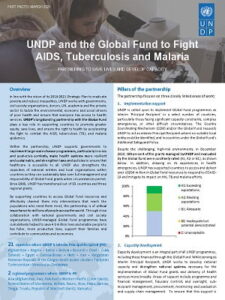
UNDP has partnered with the Global Fund since 2002 to support and strengthen national responses to HIV, tuberculosis (TB) and malaria, assisting countries to implement large-scale health programmes, including reaching some of the most hard-to-reach populations, and strengthening institutions’ ability to deliver essential services in challenging and high-risk country contexts. UNDP is managing 29 Global Fund grants, covering 21 countries and 2 Regional Programmes. This totals to a signed grant amount of US$ 1,498,417,869 for UNDP’s Global Fund portfolio.
While acting as the interim PR, UNDP develops national capacity and strengthens national systems with the aim of transferring the role of PR to national entities when circumstances permit. UNDP also strengthens local organisations within countries to enhance their capacities for grant implementation activities. Additional information on the focus areas of the UNDP-Global Fund partnership, along with guidance and resources for UNDP and partners’ implementation of the Global Fund and other health programmes, can be found in the online UNDP-Global Fund and Health Implementation Guidance Manual
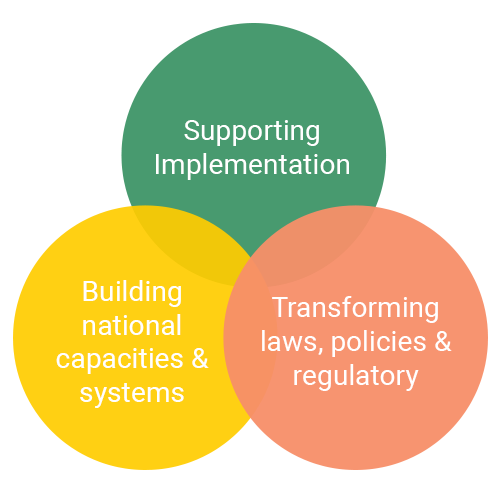
With its particular expertise and experiences, UNDP’s focus within the partnership includes:
UNDP supports countries in aligning their Global Fund applications with national disease and health strategies, and also more broadly helps countries with their national development and poverty reduction strategies. It also engages countries in a strategic dialogue about the sustainable financing of health programmes, especially middle-income countries, where the Global Fund support will eventually be phased out.
Over the years of its partnership with the Global Fund, UNDP has become a leader in implementing health programmes in the most difficult crisis contexts and the worst conflict-affected countries. It has managed the Global Fund grants in Iraq, Mali, Syria, South Sudan, Afghanistan and other countries in crisis. In Iraq and Syria, where UNDP served as interim Principal Recipient (PR) before transitioning out of this role in 2016, it was able to reach tuberculosis patients in areas controlled by the Islamic State of Iraq and al-Sham (ISIS) and other contested areas. Under the Global Fund Development Continuum Working Group, UNDP chaired a sub-working group focusing on operating in challenging environments. UNDP also supported governments in Ebola-affected countries in adjusting their Global Fund programmes. UNDP connects the Global Fund work with its early recovery mandate in crisis and post-crisis countries.
In line with its current strategy, the Global Fund is accelerating its efforts to operationalize its commitments on human rights and gender equality, and reaching key populations. UNDP supports the Global Fund to translate these commitments into action. It also leverages its role as PR to advocate for the removal of human rights and gender barriers to enable key and vulnerable populations to access services. It does so by, for example, providing policy and technical support in areas of its expertise and mandate, including on human rights, HIV and the law, and gender equality, and by strengthening community systems.
UNDP is uniquely positioned to promote environmental sustainability through health programme and policy efforts, including through innovative initiatives that embed sustainability into procurement practices and promote the use of clean energy, while also reducing the carbon footprint of health facilities and enhancing their ability to withstand the effects of climate change.
UNDP operates strictly in support, and within the framework, of national health plans and disease-specific national strategies, under the programmatic leadership of national health authorities and by supporting the crucial engagement of civil society and the private sector. Promoting national ownership, developing capacity and strengthening national systems are the overriding objectives of UNDP’s engagement – whether as an interim Principal Recipient of a Global Fund grant, a co-Principal Recipient with a national entity or a technical assignment provider to the Government. This flexibility in partnership modalities allows UNDP to provide a continuum of support tailored to local capacities and the development stage of a country. See examples of UNDP’s partnership support models here.
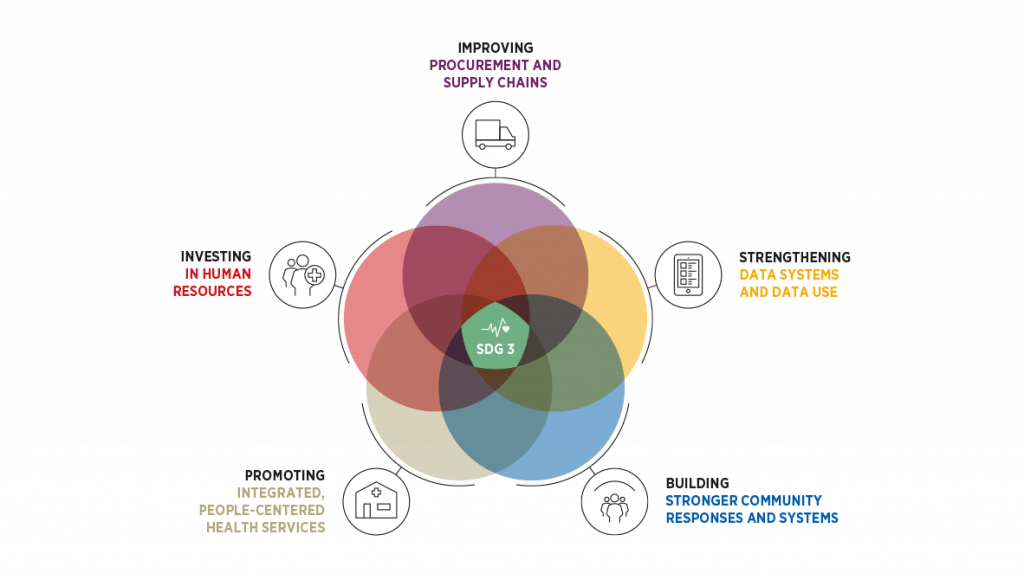
UNDP’s emphasis on and approach to capacity development aligns with the Global Fund’s strategic priorities for cross-cutting investments in health systems, responsive to the needs and constellation of partners in each country. This includes, in particular, a focus on human resources, procurement and supply chain systems, data systems and use, community systems and the promotion of integrated health services, along with other areas of work that catalyse positive multiplier effects across systems for health.
In addition to country grants, UNDP manages several multi-country programmes through the support of the Global Fund, which invests in multi-country approaches across a number of priority areas deemed critical to HIV, tuberculosis (TB) and malaria responses. These programmes focus on cross-cutting issues that are more effectively addressed across multiple countries, such as tackling human rights barriers for key populations and ensuring access to services for migrant and refugee populations.
Cumulatively, UNDP has managed five Global Fund multi-country grants as PR since 2002, covering 39 countries. This included the Africa Regional Grant on HIV: Removing Legal Barriers until 2019, which supported 10 African countries to strengthen the legal and policy environment to reduce the impact of HIV and TB on key populations, including through regional policies and mechanisms. The Lessons Learned report on the Africa Regional Grant and other multi-country key population programmes underlines the unique contribution of regional and multi-country approaches to strengthening the capacities of civil society organizations and other key stakeholders to remove human rights barriers to HIV and TB services for key populations.
UNDP also manages a regional programme to address the cross-border challenge of TB and migration in South Asia working closely with national governments and other partners including the World Health Organization (WHO), the Stop TB partnership, the Office of the United Nations High Commissioner for Refugees (UNHCR) and the International Organization for Migration (IOM). Through a multi-country Global Fund grant (2022-2024), UNDP supports the provision of TB prevention, care and treatment services for migrants, refugees and returnees in Afghanistan, Iran and Pakistan. This involves working closely with refugee, migrant and returnee communities in all three countries to train community health workers, to ensure communities are involved in programme decisions and to develop information, education and outreach programmes that are delivered in ways that people can access and understand. Multisectoral, multi-country and concerted efforts are required to address the complex nature of mobility and instability among refugees, migrants and returnees, and the development of a regional approach to policies and practices is required to enable programmes to increase TB case detection and treatment success rates. Read more here.
An overarching goal of UNDP’s role as interim Principal Recipient (PR) of the HIV, tuberculosis and malaria programmes of the Global Fund to Fight AIDS, Tuberculosis and Malaria (The Global Fund) in countries where challenging operating environments exist is to develop the capacity of national entities to take over the management of the grants as soon as circumstances permit or to improve the national entities’ performance if they are already serving as PRs. UNDP’s tailored capacity development approach and emphasis on working with and through national systems and strategies has enabled it to successfully transition out of the role of PR in 33 countries and for three regional grants since 2003.
To ensure that its support for capacity development within the Global Fund grants is systematic, country owned and evidence based, UNDP has developed a comprehensive process and standard tools to jointly assess capacity gaps and work with key stakeholders to develop capacity development and transition plans. Once launched at the beginning of a grant, the establishment of these plans allows identified capacity gaps to be translated into concrete deliverables and outcomes with specific entities responsible for each, according to a clear timeline and associated budget. The process likewise ensures that progress can be monitored in all core functional areas of national health systems and project management arrangements, including capacities related to programming, monitoring and evaluation, supply chain management and financial management. The map below includes examples of priorities established through capacity development plans in countries where UNDP serves as interim Principal Recipient of the Global Fund grants. The Capacity Development Plan and Transition sections of this website outline the framework, tools and guidance for countries to plan, develop and monitor capacity development plans for health programmes and broader systems strengthening.
UNDP-supported capacity development and transition plans are not intended to replace the Global Fund risk assessments. An example of an external risk assessment is the Global Fund assessment of potential Principal Recipients (PRs), which is carried out by the Local Fund Agent (LFA). The Global Fund assessment is similar to a capacity assessment; however, the LFA assessment is risk based and aims to determine the risks for the Global Fund.
In In this map, you will find an overview of the Global Fund grants UNDP manages as interim Principal Recipient (PR). Based on government demand, UNDP also provides technical assistance to strengthen systems in a number of countries through financing agreements funded by domestic or other donor resources.

Capacity Development for Health
https://beta-cd4health.org
Generated on December 13, 2025 at 3:42 PM